Think Fast, Speak Faster!
I’ve always taken joy in training children and youths in the craft of public speaking, and see them acquire the knowledge, and applying them in real-life. Sometimes, that will spark a whole new speaking journey for them – for example, my student and intern back in 2018, Jing En (one of our senior trainers), has now forayed into the realm of emceeing (being a professional compère/ master of ceremonies/ event host) – applying his public speaking knowledge and experiences to their fullest! (Interested to learn about Jing En’s journey? Check it out in this Straits Times article: https://www.straitstimes.com/singapore/how-ntu-bus-guy-went-from-the-shy-kid-to-vlogger-and-emcee?ref=search-results)
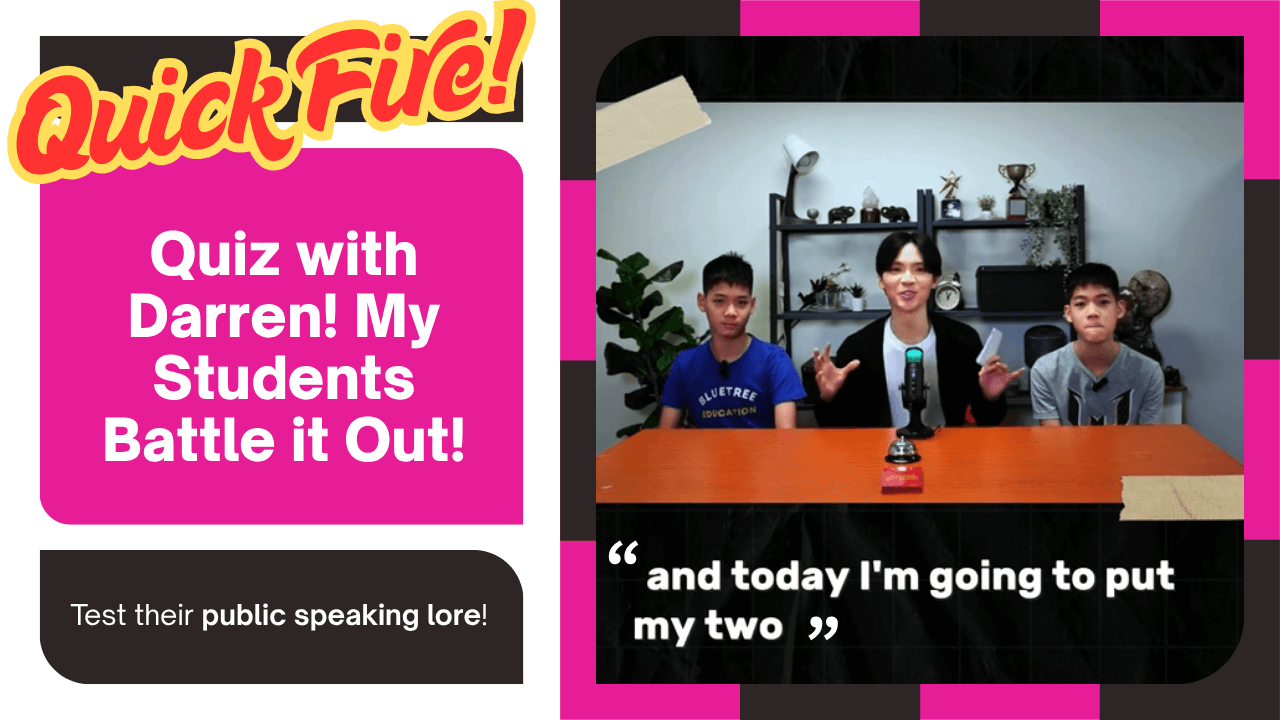
I put two eager students from my public speaking class, twin brothers Isaac and Matthew, to the test in a "faster finger first" competition in this entertaining and quick-paced video challenge. Equipped with buzzers and fast thinking, players compete by responding to nine fast-paced questions about body language, communication, and public speaking. This friendly competition is not only entertaining but also full of fast tips for anyone wishing to improve their speaking abilities, covering everything from speech structures to narrative and even how to pronounce "success.". Ready to play along? You may watch the full YouTube video (on YouTube) here - Quiz with Darren! World Champion’s students battle it out – test their public speaking lore!
I have also expanded their answers to all the questions posed below (add more tips and strategies), hopefully you will find even more value from this blog post!
Q1. Name one way to have a captivating introduction to a speech.
According to Monroe’s Motivated Sequence (ANSVA), the first component is A – attention! People's attention spans these days are getting shorter and shorter, and the younger they get, the worse it gets. Your audience will spend anywhere from 15 seconds to one and a half minutes with you. In this moment of opportunity, your hook needs to be surprising.
Begin your presentation with something shocking that will hold their interest for at least fifteen seconds. That’s why the response given is correct “Begin with a hook, like a piece of statistics, 30% blah blah blah…”.
Using a personal anecdote or native story to begin a speech is another effective strategy. Storytelling instantly engages the audience on an emotional level and lends your message a relevant, human touch since humans are wired for it. Within the first few seconds, a well-told story establishes the mood, piques interest, and establishes a rapport with your audience.
In short...
Stories trigger emotional connection and curiosity: Carmine Gallo, author of Talk Like TED (Macmillan, 2014) (page 50) referred to experiments by Uri Hasson, an assistant professor of psychology at Princeton University, in highlighting the phenomenon of “brain-to-brain coupling”, or as Carmine succinctly puts it, “sync up” between the storyteller’s and listeners’ brains. Injecting stories into your presentation helps “show-and-not-tell” your core points, and makes your message more relatable.
Storytelling makes your message more memorable: A riveting story that underscores the main message will boost knowledge retention of the audience members, because the characters’ interaction, the emotions churned, the psychological impact felt, will JOLT the mind of the main message.
For instance, a story about a mother dropping a dollop of honey on her kid’s book every now and then to remind the child that knowledge is sweet, the process of acquiring knowledge can be sweet too – this is going to reinforce the main message of “education for the sake of gaining knowledge is rewarding” whenever the audience thinks about “mother & child + honey on book”.
Storytelling enhances presenter’s authenticity and builds speaker credibility early: Giving speeches and presentations isn’t only about disseminating knowledge. Give your audience the “Hey, that happened to me too!” feeling and build immediate rapport. Stories help to ‘humanize’ your sleep-inducing data, theories, and facts; stories that engender shared experiences help to evoke the feeling that “We’re in this together.”
Share some relatable details of your life with the audience to make your speech more human. We all have fears, including those related to public speaking, commitment, mediocrity, failure, loneliness, heights, and spiders. Some would contend that disclosing one’s own fears exposes weaknesses or signals weakness. Why not approach it from a positive angle? These are moments to participate in human-to-human stimulations and press emotional triggers to help your message stick. In the end, acceptance of your speech by your audience matters much more than the perfection of your performance.
WATCH on YouTube: “How To Start Your Speech or Presentation | 4 Effective Tips To Hook The Audience” - https://youtu.be/fZSHeNiyeLo
Q2. Name me one speech structure used to craft short speeches or quick-fire responses.
As mentioned in the response, the PEEL method is a simple, effective structure for short speeches and impromptu answers. PEEL stands for Point, Explanation, Example, Link. It helps you organize your thoughts quickly while sounding confident and cogent, making it ideal for Q&A sessions, interviews, and extemporaneous speaking situations.
In short...
Use PEEL (stands for Point, Explain, Example, Link) to structure thoughts quick: State your point, provide the reason, support with evidence and reinforce your point. For example, in response to the question “Why should be consume dietary fibre/ vegetables?”. Stay clam. Start with “Fibre intake helps to reduce glucose spikes that are unhealthy to the body. (Point)”. Followed by “Because the presence of fibre slows down the digestion and absorption of carbohydrates, so the ‘spikes’ don’t hit the body! (Explain)”, followed by “Fibre is like a traffic cop at a busy intersection who slows things ‘sugar’ traffic and directs the flow steadily instead of a mad rush.”, and then conclude with “that is why, consuming dietary fibre is good for the body.”.
Speech structures, like PEEL, helps you stay focused and structured under pressure: When under pressure to give a quick response, mind blank or mental block is a real possibility. The answer may just be swimming in a swamp of other thoughts like “That’s an aggressive question…”, “Why is he or she asking that?, “What if I mess this up?”…Take a deep breath and always fall back on the PEEL speech structure to systematically provide a cogent reply.
Ideal for quick-fire answers and mini speeches: Such speech situations do not offer the luxury of time to go through the entire process of a prepared presentation, from crafting to refining, to rehearsing with unlimited time. The enquirer is waiting for a response, on-the-spot! A couple of questions may even be levelled at you simultaneously in such situations. You need a framework that allows you to simply populate the “fields/ elements like PEEL” in an organized flow.
Stay tune for part 2 where we expand on questions #3 and beyond – on benefits of public speaking, pronunciation, and more!
More tips on public speaking & communication skills
Check out our tips on the following five communication topics:
Speaking Confidence Building Strategy
Effective Presentation Techniques
Impromptu Speaking / Think-fast-on-the-feet skills
Our Public speaking & Presentation Skills Training Courses
If you’re keen on taking your communication skills to the next level, to improve your persuasive speaking skills through our training programs:
Click for more about our (weekly group classes) Public Speaking Courses for Adults
Click for more about our (2-day) public speaking/ presentation course for adults
Click for more about our (weekly group classes) Public Speaking Course for Kids / Children
Click for more about our (2-day) public speaking holiday program for Kids / Children
Click for more about our (2-half-day) DSA interview skills holiday program for Kids / Children