Imagine your child is preparing for the PSLE English Oral Examination.
You ask a simple question:
"Do you think children should help with household chores?"
Your child responds:
"Yes, because it is good and they can help their parents."
You wait.
Your child looks at you.
And that's the end of the answer. 😂
Now, here's the interesting part.
Your child may not actually lack ideas.
They may have helped with household chores many times. They may understand responsibility, appreciate their parents' efforts and have plenty of relevant experiences to share.
The problem may simply be that they haven't learnt how to turn those ideas into a complete, meaningful response.
According to Darren Tay, Founder of Public Speaking Academy and the 2016 World Champion of Public Speaking, this is one of the most common challenges students face when preparing for Stimulus-Based Conversation (SBC).
And the solution isn't necessarily to memorise longer model answers.
It's to learn how to listen carefully, develop ideas, organise thoughts and communicate naturally.
In this guide, we'll explore Darren's practical coaching techniques, including how to use a photograph stimulus, how to elaborate without rambling, and how to respond when the examiner asks an unexpected follow-up question.
What Is Stimulus-Based Conversation in PSLE English Oral?
Stimulus-Based Conversation is one of the two components of the PSLE English Oral Communication examination.
Under the 2026 Singapore Examinations and Assessment Board (SEAB) English Language syllabus, the Oral Communication paper carries 40 marks, representing 20% of the overall English examination.
The two components are:
Reading Aloud — 15 marks
Stimulus-Based Conversation — 25 marks
Candidates are given five minutes of preparation time before the oral examination, which lasts approximately five minutes.
For Stimulus-Based Conversation, a photograph serves as the stimulus for a conversation between the student and examiner.
The objective isn't simply to describe everything visible in the photograph.
Students need to understand the questions, express relevant ideas, develop their responses and engage meaningfully in the conversation.
SEAB has also clarified that students are not expected to reproduce pre-prepared responses.
This is an important distinction because a child can memorise an impressive paragraph without necessarily being able to answer a question effectively.
For a broader introduction to both oral components, read our PSLE English Oral preparation guide.
Official reference: SEAB 2026 PSLE English Language syllabus. Students preparing for a later examination year should consult the syllabus applicable to their cohort.
The Three Most Common Weaknesses in Stimulus-Based Conversation

After years of coaching children in public speaking and oral communication, Darren identifies three recurring weaknesses.
Interestingly, none of them can be solved simply by telling children to speak more confidently.
1. Lack of Meaningful Elaboration
Consider this question:
"Do you think students should participate in outdoor activities?"
A child responds:
"Yes, because outdoor activities are healthy and fun."
That's a relevant answer.
But it doesn't explain much.
Why are outdoor activities healthy?
What makes them enjoyable?
How might they benefit children?
Darren explains that making a point is only the beginning. The real value comes from explaining and illustrating it.
Instead of merely telling the child to make the answer longer, we should help them understand what meaningful information is missing.
2. Lack of Structure
Other children have the opposite problem.
They have plenty to say!
Unfortunately, the ideas sometimes arrive in no particular order.
A child discussing outdoor activities might begin with exercise, jump to a school excursion, talk about friendships, return to physical fitness and suddenly mention a family holiday.
Each idea might be relevant individually.
But without a logical progression, the listener struggles to understand the main message.
This is why learning to organise an answer is just as important as generating ideas.
3. Excessive Memorisation
Some students prepare elaborate answers about familiar themes such as technology, environmental conservation and healthy living.
But what happens when the examiner asks a slightly different question?
For example:
"Should schools make outdoor activities compulsory?"
A child might launch into a rehearsed explanation about the benefits of exercise.
But the important word in the question is compulsory.
The examiner isn't merely asking whether outdoor activities are beneficial.
The question requires the student to consider whether participation should be mandatory.
Darren has encountered students who become so focused on recalling memorised content that they fail to listen carefully to the actual question.
A polished answer that misses the question is still a weak response.
As Darren explains:
"A strong SBC response is not measured by how many words a student can produce, but by how clearly, thoughtfully and relevantly the student communicates."
How to Develop a Strong SBC Answer Using PEEL
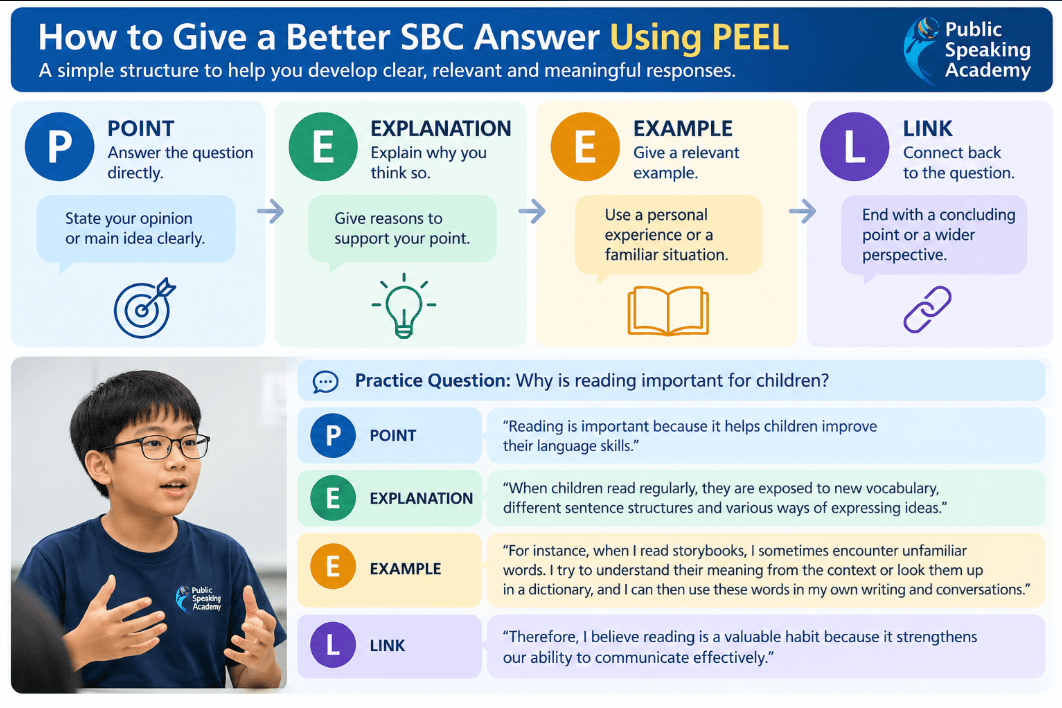
One structure Darren teaches students is PEEL:
P — Point
E — Explanation
E — Example
L — Link
The objective isn't to turn a conversation into a rigid, memorised essay.
It's to give children a simple mental roadmap for developing their ideas.
Let's take a common question.
"Why is reading important for children?"
Point: Answer the Question Directly
"Reading is important because it helps children improve their language skills."
This gives the listener a clear position.
Explanation: Explain Why
"When children read regularly, they are exposed to new vocabulary, different sentence structures and various ways of expressing ideas."
Now the child has explained the reasoning behind the point.
Example: Make the Idea Concrete
"For instance, when I read storybooks, I sometimes encounter unfamiliar words. I try to understand their meaning from the context or look them up in a dictionary, and I can then use these words in my own writing and conversations."
The example helps the listener understand how the idea applies in practice.
Link: Return to the Question
"Therefore, I believe reading is a valuable habit because it strengthens our ability to communicate effectively."
The response now has a natural sense of completion.
Notice that the answer doesn't need several complicated arguments.
One clearly developed point can be more effective than several undeveloped points.
And PEEL is a guide, not a compulsory script. In a real conversation, children should still respond naturally to the question and follow-up prompts.
Before and After: Turning a Short Answer Into a Meaningful Response
Let's return to our household-chores example.
Examiner's question:
"Do you think it is important for children to help with household chores?"
The Initial Answer
"Yes, I think children should help with household chores because it is good and they can help their parents. I sometimes help my mother wash the dishes."
This answer contains a position and the beginnings of a personal example.
But it lacks depth.
Instead of immediately supplying a better paragraph, Darren would guide the child through three questions.
Question 1: Explore the reasoning
"Why is it important for children to help their parents, apart from simply making their parents' lives easier?"
This encourages the child to consider responsibility, independence and appreciation.
Question 2: Retrieve a specific experience
"Can you tell me about a particular occasion when you helped with household chores? What happened?"
This moves the child away from vague statements towards something concrete.
Question 3: Reflect on the significance
"What did that experience teach you, and how might it benefit you when you grow older?"
This helps the child connect the experience to a broader lesson.
A Stronger Example Answer
"Yes, I believe children should help with household chores because it teaches us responsibility and helps us appreciate the hard work our parents put into taking care of the family.
"For example, last weekend, my mother was busy preparing dinner, so I offered to wash the dishes and clean the dining table.
"Although these were simple tasks, I realised that household chores can take up a lot of time, especially when one person has to do everything.
"By helping my mother, I was able to reduce her workload, and I also felt proud that I could contribute to the family.
"I think learning to do household chores from a young age is important because when we grow older, we will need to take care of ourselves instead of depending on others."
This is an illustrative answer developed from Darren's coaching method, not a transcript of a particular student's examination.
The difference isn't simply that the second answer contains more words.
It has a clear position, explanation, specific experience and meaningful reflection.
Most importantly, the child is learning how to develop an answer, rather than memorising this particular response.
How to Use a Photograph Stimulus: Observe, Connect and Reflect
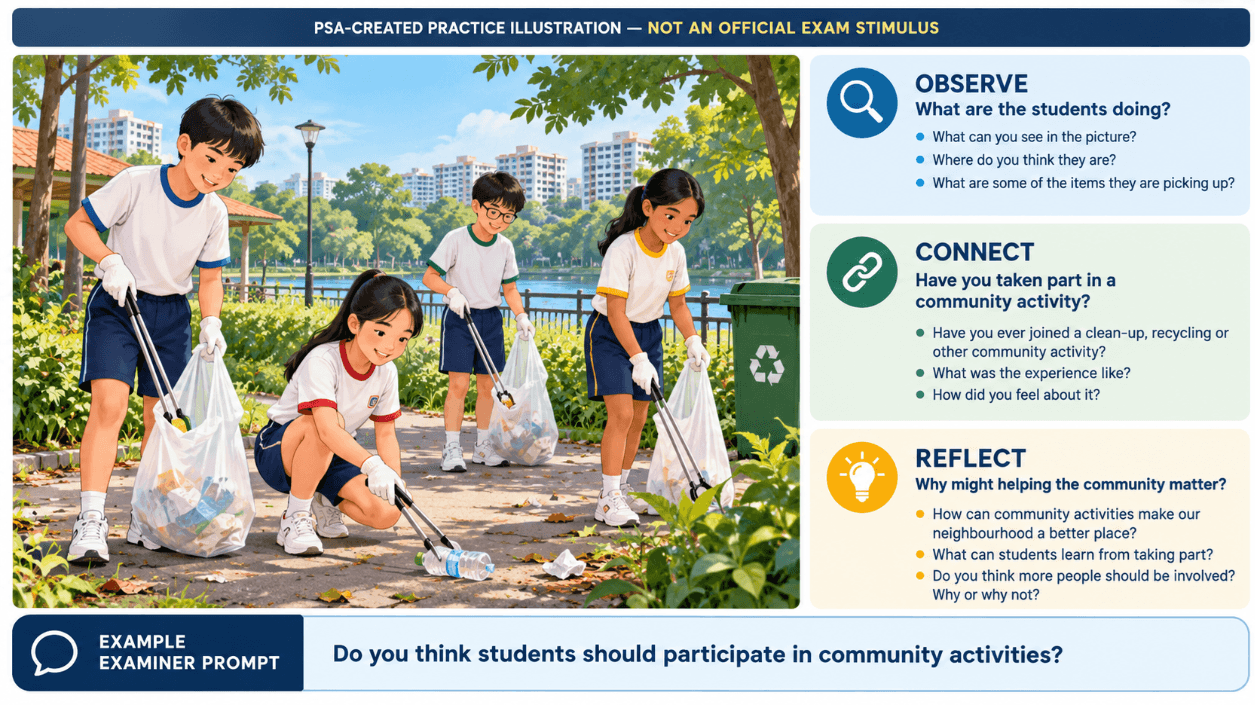
When students encounter a photograph stimulus, some immediately begin describing everything they can see.
"There are four children."
"One is wearing a blue shirt."
"There are some rubbish bags."
"The weather looks sunny."
And so on.
But what if the examiner asks:
"Do you think it is important for students to participate in community activities?"
Listing every visible object doesn't necessarily answer the question.
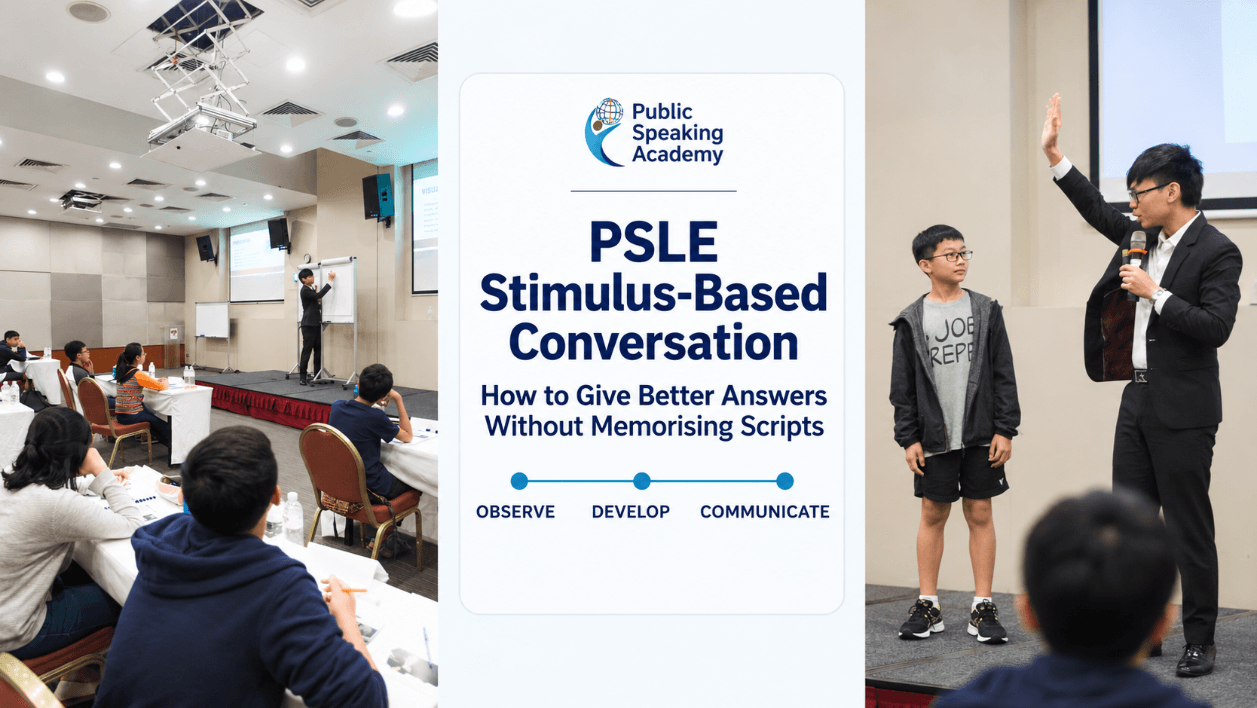
Darren therefore teaches a simple progression:
Observe → Connect → Reflect
Step 1: Observe Something Relevant
Identify a detail in the photograph that relates to the examiner's question.
Imagine a photograph showing children taking part in what appears to be a community clean-up.
A relevant observation might be:
"The photograph shows children participating in what appears to be a clean-up activity."
Notice the careful wording: appears to be.
We should avoid claiming details that cannot be established from the photograph.
Step 2: Connect the Observation
Connect the visual detail to a relevant opinion, personal experience or familiar situation.
For example:
"This reminds me of a school event where my classmates and I helped collect litter around our neighbourhood."
Now the student has something meaningful to discuss.
Step 3: Reflect on Its Significance
The child can explain what happened, what they learnt and why the activity mattered.
Perhaps the experience encouraged teamwork.
Perhaps it helped the student appreciate the importance of keeping shared spaces clean.
Perhaps it changed the way the student thought about community responsibility.
The strongest connection is one that genuinely helps answer the question.
Don't Force Every Answer Into a Personal Story
This is an important qualification Darren makes.
Suppose the examiner asks:
"Should public spaces have more recycling bins?"
A child doesn't necessarily need to invent a story about recycling at home.
A relevant answer could discuss how accessible recycling bins may encourage responsible disposal, while also recognising the importance of public education so people use the bins correctly.
Personal experiences are useful when relevant. They are not compulsory ingredients in every answer.
The photograph should help generate ideas.
But the examiner's question must remain the focus.
How to Elaborate Without Rambling: Darren's New Value Test
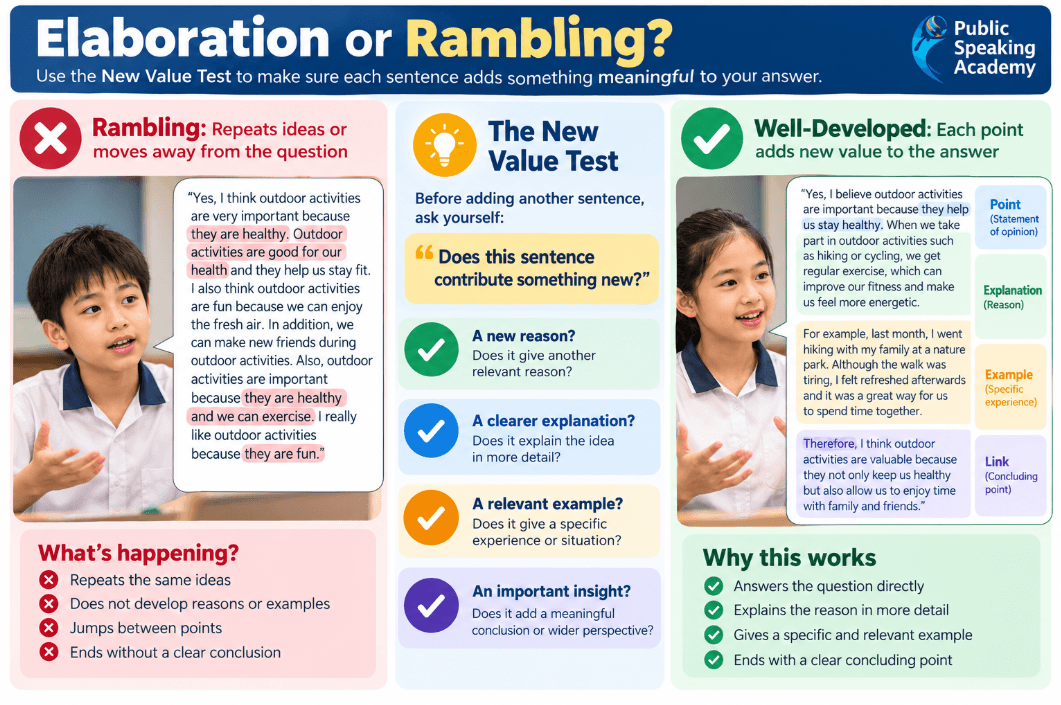 *** Longer response doesn't always mean better! Learn to distinguish meaningful elaboration from rambling using the New Value Test. ***
One misconception Darren frequently encounters is that a longer response automatically means a better response.
It doesn't.
Elaboration adds meaningful information.
Rambling adds unnecessary information.
A child who repeats the same opinion using five different sentences hasn't necessarily developed the answer.
Likewise, a child who introduces several unrelated experiences may make the response harder to follow.
Darren teaches students what he calls the New Value Test.
Before adding another sentence, consider:
Does this sentence contribute something new?
For example:
A new reason?
A clearer explanation?
A relevant example?
An important insight?
If the next sentence merely repeats an existing point, it may not need to be included.
Darren also asks students to review their responses and identify sentences that could be removed without changing the meaning.
This trains them to distinguish useful information from unnecessary detail.
For students who tend to ramble, he may impose a time limit during practice—not to encourage rushing, but to help them prioritise.
For students who give overly brief responses, he may do the opposite: ask them to elaborate meaningfully on one point before introducing another.
The goal is completeness, not length.
As Darren explains, a good answer should leave the listener feeling that the question has been answered convincingly, without wondering why the speaker is still talking.
How to Handle Unexpected SBC Follow-Up Questions
A genuine conversation doesn't follow a fixed script.
The examiner might challenge an opinion, introduce a different perspective or ask the student to consider a new situation.
Children therefore need to become comfortable adapting.
Darren uses several exercises to develop this ability.
Exercise 1: Listen, Identify and Respond
This exercise trains students to listen to the entire question, identify what is being asked and respond directly before elaborating.
Imagine a student has just explained why school excursions are beneficial.
The examiner follows up:
"What difficulties might teachers face when organising such excursions?"
The question has changed.
The student is no longer being asked to explain the benefits.
They must now consider challenges.
A relevant answer might discuss student safety, logistics or managing a large group.
The ability to recognise this shift is essential.
Exercise 2: The "What If?" Drill
Darren introduces unexpected hypothetical situations to encourage flexible thinking.
For example, a student says:
"Technology improves learning."
Darren might ask:
"What if students become too dependent on technology?"
Or:
"What if some families cannot afford digital devices?"
The child now has to consider limitations and alternative perspectives.
Importantly, acknowledging a limitation doesn't necessarily mean abandoning the original opinion.
Exercise 3: Agree, Disagree and Qualify
Not every question requires an extreme position.
For example:
"Do you think homework is beneficial?"
A child might agree that homework helps students practise what they have learnt.
But they could also recognise that excessive homework may reduce time for rest, family activities and other interests.
This is a more nuanced response than insisting that homework is either entirely good or entirely bad.
The goal is to take a position, support it with reasoning and recognise reasonable exceptions.
Exercise 4: Rapid Topic Switching
Darren may ask students questions about several unrelated themes in quick succession.
Friendship.
Environmental conservation.
Technology.
Family responsibilities.
The objective isn't to produce a perfect answer immediately.
It's to develop mental flexibility and reduce the fear of unfamiliar topics.
Students learn that they can approach new questions using transferable thinking skills rather than relying on memorised paragraphs.
And yes, a brief pause to organise thoughts is perfectly acceptable.
It is often more useful than immediately filling the silence with repeated "erm", "actually" or "I think".
For children who frequently struggle with unexpected questions, our article on why children freeze when asked to speak explores this challenge in greater detail.
Does a Child Who Gives Short Answers Necessarily Lack Ideas?
Not at all.
Consider this illustrative coaching scenario.
A child is asked:
"Do you enjoy participating in group activities?"
The child answers:
"Yes, because it is fun and I can play with my friends."
When asked to elaborate, the child repeats essentially the same idea.
"I like group activities because my friends are there and we can have fun together."
It may appear that the child lacks vocabulary or ideas.
But a trainer needs to investigate further.
Darren might ask the child to describe a recent group activity informally, without worrying about producing a polished response.
Suddenly, the child can remember plenty:
Who participated.
What they did.
What challenges arose.
How they felt.
What they learnt.
The information was there all along.
The difficulty was retrieving, selecting and organising it into an answer.
Darren's approach is to introduce a simple structure—opinion, reason, specific example and reflection—before gradually reducing the number of prompting questions.
He also varies the practice questions so the child learns a transferable skill rather than memorising one improved response.
For instance, a stronger answer about group activities might explain how working with classmates on a school project taught the child teamwork, patience and the importance of listening to others.
The improvement we're seeking is not simply more words.
It's the ability to express an idea clearly, substantiate it and draw a thoughtful conclusion.
This example illustrates Darren's coaching approach; it is not presented as a documented transformation of one identifiable student.
How Parents Can Practise Stimulus-Based Conversation at Home

Here's some good news.
Parents don't necessarily need to become professional oral examiners. 😂
In fact, one of the most useful things parents can do is resist the temptation to provide a perfect answer immediately.
Instead, ask questions that help the child develop their own thinking.
For example:
"Why do you think that?"
"Can you give me an example?"
"What happened next?"
"What did you learn?"
"Could there be another point of view?"
You can use photographs of everyday situations, school experiences, family activities or issues your child encounters.
Ask a relevant question, listen to the answer and choose one or two follow-ups.
If your child gives a brief response, help them develop the idea.
If your child rambles, help them identify which details actually contribute value.
If your child gives an answer that misses the question, gently direct their attention back to the wording.
And if your child needs a few seconds to think, allow that pause.
As Darren has previously explained:
"There is a time for correction and a time for expression."
The goal is not to turn every conversation into an examination.
It's to help children become increasingly comfortable expressing opinions, explaining ideas and listening to other perspectives.
Five Things to Remember During Stimulus-Based Conversation
Before entering an oral examination, children don't need twenty different frameworks running through their minds.
Darren's coaching principles can be condensed into five reminders.
1. Listen to the actual question.
Pay attention to important words, especially when the examiner introduces a condition, comparison or different perspective.
2. Answer directly.
Begin with a relevant position or idea instead of delivering a rehearsed introduction.
3. Develop one point meaningfully.
Use a reason, explanation, example or reflection where appropriate.
4. Use the photograph as a starting point.
Observe relevant details, connect them to the question and reflect on their significance without inventing unsupported information.
5. Know when you've said enough.
Use the New Value Test. If another sentence doesn't contribute something useful, there's no need to keep talking.
Most importantly, remember that the examiner is having a conversation with you.
Your job isn't to recite the perfect answer. It's to communicate your own thinking clearly.
Developing Stronger Oral Communication Skills Beyond PSLE
Stimulus-Based Conversation is an examination component, but the underlying skills are useful far beyond Primary 6.
Listening carefully.
Understanding questions.
Forming opinions.
Explaining reasons.
Retrieving relevant experiences.
Considering different perspectives.
Speaking clearly and naturally.
These are the same communication abilities children will continue using in classroom discussions, presentations, interviews and everyday conversations.
At Public Speaking Academy, our approach to public speaking training emphasises theory, hands-on speaking opportunities and specific feedback.
Our weekly Speech Excellence Programme for children and teenagers develops skills including speech delivery, impromptu speaking, organising ideas and communicating confidently.
We also offer a 2-Day S'Peak Performance Kids Holiday Programme for students who would benefit from an intensive introduction to practical speaking skills.
For parents considering enrichment options, our guide on choosing the right public speaking class for your child explains what to look for in training, speaking opportunities and feedback.
Ultimately, our objective is not simply to help children memorise impressive-sounding answers.
It is to help them become more independent, thoughtful and capable communicators.
Frequently Asked Questions About PSLE Stimulus-Based Conversation
What is Stimulus-Based Conversation in PSLE English Oral?
Stimulus-Based Conversation is the conversation component of PSLE English Oral Communication. Under the 2026 syllabus, it carries 25 marks out of the 40 marks available for Oral Communication. Students respond to questions based on a photograph stimulus, expressing and developing relevant ideas through conversation with the examiner.
How can my child give longer answers in PSLE Oral?
Instead of focusing on length, teach your child to develop one relevant idea using a clear point, explanation, example and link. Ask follow-up questions such as "Why?", "Can you give me an example?" and "What did you learn?" The objective is a complete, meaningful response rather than unnecessary elaboration.
Should my child describe everything in the SBC photograph?
No. The photograph provides a starting point for conversation. Children should identify details relevant to the examiner's question rather than describing every visible object. Darren recommends the progression Observe, Connect and Reflect to help students use the photograph meaningfully.
Is PEEL suitable for PSLE Stimulus-Based Conversation?
PEEL can be a useful structure for organising ideas: Point, Explanation, Example and Link. However, students should use it flexibly. The objective is to communicate naturally, not to make every response sound like a rehearsed essay.
What if my child doesn't have a personal experience related to the question?
A personal story is not compulsory. Children can use relevant reasoning, familiar situations, observations or examples. They should never invent experiences simply to make an answer sound more impressive.
How do I stop my child from rambling during oral practice?
Teach your child Darren's New Value Test. Each additional sentence should contribute a new reason, clearer explanation, relevant example or important insight. If it merely repeats an existing point or moves away from the question, it probably doesn't need to be included.
How should my child handle unexpected follow-up questions?
Listen carefully to the entire question, identify what has changed and respond directly. Practising hypothetical "What If?" questions, alternative perspectives and rapid topic switching can help children become more adaptable. A short pause to organise thoughts is acceptable.
About Darren Tay
Darren Tay is the Founder and Master Trainer of Public Speaking Academy and the 2016 World Champion of Public Speaking.
His training work includes children, teenagers and working professionals, with an emphasis on structured techniques, repeated speaking practice and actionable feedback.
For Darren, effective oral communication isn't about producing the longest or most impressive-sounding answer.
It's about understanding the question, developing your own ideas and communicating them with clarity and purpose.