

Your child knows the answer.
Their teacher asks the class a question. Their hand almost goes up — but doesn't.
Or perhaps they can happily explain an entire story to you at home, yet the moment they have to present the same idea in front of their classmates, their voice becomes softer. Their eyes drop. The words suddenly become harder to find.
For parents, the instinctive response is often:
“Just be confident!”
The advice is well-intentioned. Unfortunately, confidence doesn't usually appear simply because a child has been told to have it.
After years of coaching young speakers, I have found that a more effective starting point is to help children accumulate small, successful speaking experiences. Instead of immediately expecting a shy child to perform confidently before a large audience, we can begin somewhere safer, reinforce what they are already doing well, teach them specific communication skills, and progressively increase the challenge.
Each successful experience then gives the child something extremely valuable:
Evidence that they can do it.
That distinction matters.
A shy child does not necessarily need to become the loudest child in the room. Neither does an introverted child need to become an extrovert.
The goal is simpler: to equip children with the confidence and communication skills to express themselves effectively when the situation calls for it.
Why does my child seem confident at home but shy when speaking in public?
Public speaking introduces something that ordinary conversation often doesn't: the feeling of being observed and evaluated.
A child who talks endlessly at the dinner table may behave very differently when 30 classmates suddenly turn towards them.
They may worry:
What if I forget what I want to say?
What if everyone laughs?
What if my answer is wrong?
What if my voice sounds strange?
What if I make a mistake?
Once these thoughts become associated with speaking in front of others, even a simple classroom presentation can feel disproportionately intimidating.
There is also an important distinction between wanting to participate but feeling inhibited and simply preferring less social interaction. Research into childhood social withdrawal similarly distinguishes conflicted shyness — where a child may want to interact but feels inhibited — from social disinterest.
That brings us to an important question.
Is a shy child the same as an introverted child?
No. Shyness and introversion should not automatically be treated as the same thing.
At Public Speaking Academy, we make an important distinction between the two.
Shyness is often more situational and functional. A child may be uncomfortable presenting in front of a particular person, a group of classmates or an unfamiliar audience because they fear embarrassment or judgment.
Introversion, on the other hand, is a personality characteristic commonly associated with a preference for quieter environments and lower levels of social stimulation.
An introverted child can still be an excellent public speaker.
In fact, I personally identify as an introvert.
As a teenager, I was extremely shy as well.
In my book Express to Impress, published years before I became the 2016 World Champion of Public Speaking, I wrote about being an extremely shy Secondary 1 student who avoided eye contact when teachers asked questions.
Things began to change when one of my teachers encouraged me to give a classroom presentation. I rehearsed it in front of a mirror the night before. After I presented, my teacher praised my performance in front of the class.
What mattered to me wasn't that the presentation was perfect.
It was that I had taken a first step beyond my comfort zone.
Soon afterwards, I accepted another opportunity to speak before a larger audience. That eventually opened other doors in my speaking journey.
Years later, that experience still influences the way I think about helping shy young speakers.
We don't need to turn introverts into extroverts.
We need to help children discover that they can communicate effectively even when speaking feels uncomfortable at first.
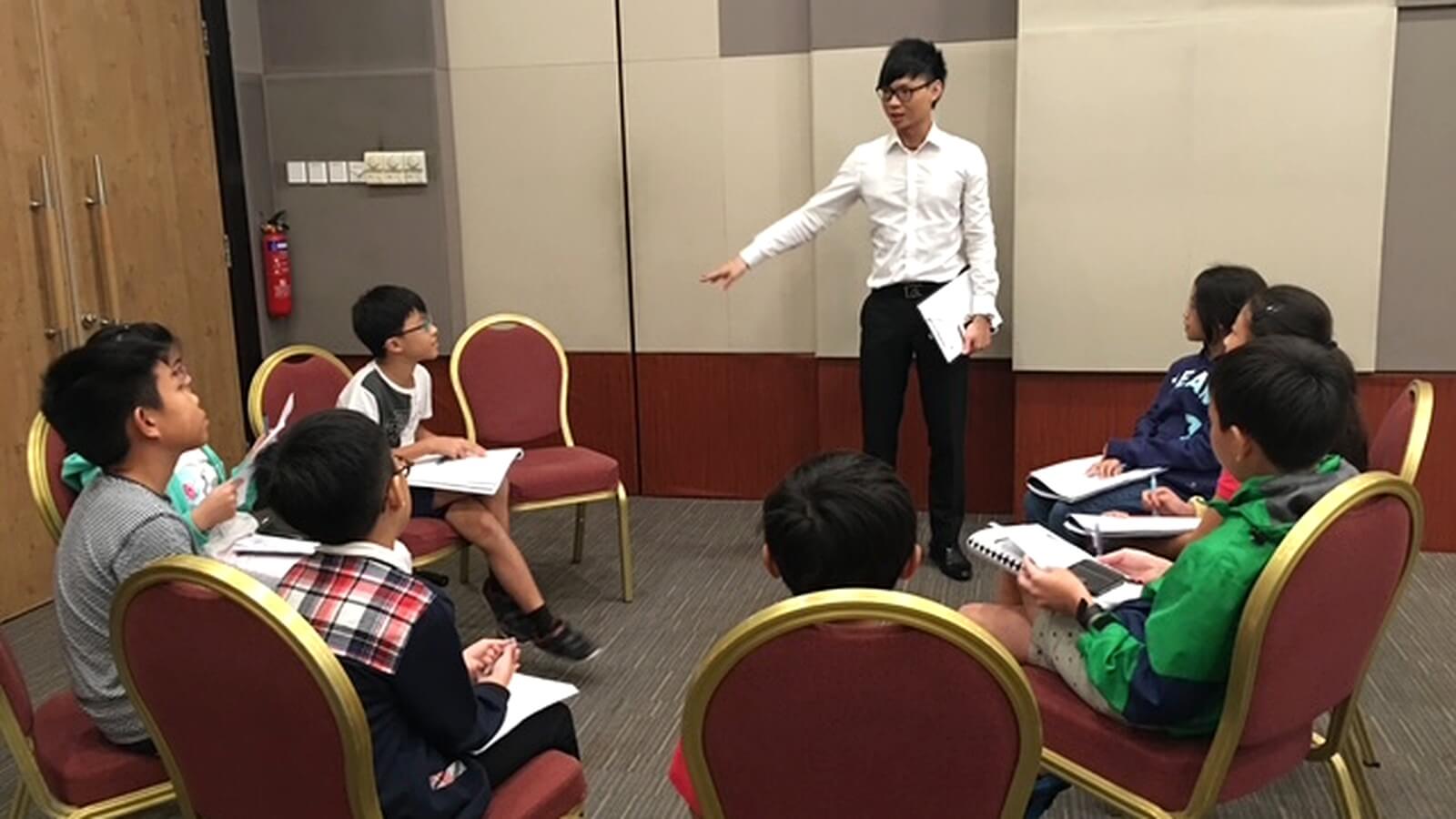
What do shy children often believe about their own speaking ability?
One recurring pattern I have noticed since I began coaching children regularly in our programmes in 2018 is a lack of positive reinforcement around their previous speaking experiences.
Based on my own coaching observations, around 70% of the shy students I have worked with struggled to identify a positive moment from their public speaking journey.
If I asked:
“Tell me about a presentation you were proud of.”
many struggled to think of one.
But ask them about something that went wrong?
They could often remember it immediately.
They remembered forgetting their lines.
They remembered speaking too softly.
They remembered feeling embarrassed.
They remembered making a mistake.
This isn't a scientific prevalence estimate for all children; it is an observation from the students I have personally coached. But it has influenced how I approach confidence-building.
If a child's internal evidence bank consists mainly of:
“I forgot.”
“I was embarrassed.”
“I couldn't do it.”
then telling that child to “be confident” does little to change the evidence they are drawing upon.
We need to help them create new evidence.
9 Ways to Help a Shy Child Build Public Speaking Confidence
1. Start smaller than you think
More than half of the shy students I have personally worked with have expressed discomfort or fear when asked to speak before groups larger than four people.
Again, this is a coaching observation rather than a population-wide statistic, but it highlights an important principle:
The first audience does not have to be a big audience.
If your child freezes when speaking in front of 30 people, repeatedly putting them in front of 30 people and hoping they eventually “get used to it” isn't necessarily the most constructive starting point.
Reduce the difficulty.
A progression might look like this:
Parent → Parent + sibling → 2–3 familiar people → small group → larger group → classroom-sized audience
The exact progression will differ from child to child.
What matters is that the challenge increases progressively.
This approach is also broadly consistent with child-development guidance that encourages adults to recognise small instances of brave social behaviour rather than defining a child by shyness, while allowing confidence to develop progressively.
At PSA, we can apply the same principle specifically to speaking.
A very shy student might initially present only to a trainer.
Then perhaps to several classmates.
Then to a larger group.
Eventually, to the entire class.
Confidence becomes the consequence of successful action — rather than a prerequisite for taking action.
2. Praise specifically, not generically
Imagine your child finishes a presentation and you say:
“Good job!”
That's encouraging.
But compare it with:
“I noticed that you looked up at us when you explained your second point. Your eye contact was much stronger there.”
Or:
“Your voice was much clearer when you slowed down during the last part.”
Now the child knows exactly what they did successfully.
Specific positive reinforcement helps a child recognise that public-speaking ability isn't one giant quality called “confidence”. It consists of individual behaviours that can be learned and improved:
eye contact, vocal projection, posture, gestures, speech structure, pace, articulation and audience engagement.
That gives the child something concrete to repeat.
It also changes the conversation from:
“Am I a good or bad speaker?”
to:
“What did I do well, and what can I improve next?”
That is a much healthier question for a developing speaker.
3. Correct one speaking behaviour at a time
Parents sometimes notice everything simultaneously.
“Speak louder.”
“Stand straight.”
“Stop moving.”
“Look at me.”
“Don't say ‘um’.”
“Smile!”
The child is now trying to remember six instructions while also remembering the speech.
😂
Instead, identify one or two behaviours that will make the biggest immediate difference.
Perhaps today the goal is simply audibility.
Once that improves, work on eye contact.
Then gestures.
Then perhaps vocal variety.
Public speaking is a collection of skills. Breaking those skills into manageable components gives children a much clearer route towards improvement.
This principle also appears much earlier in my own speaking philosophy. In Express to Impress, I encouraged speakers to begin with small, achievable and pragmatic goals rather than attempting to transform everything at once.
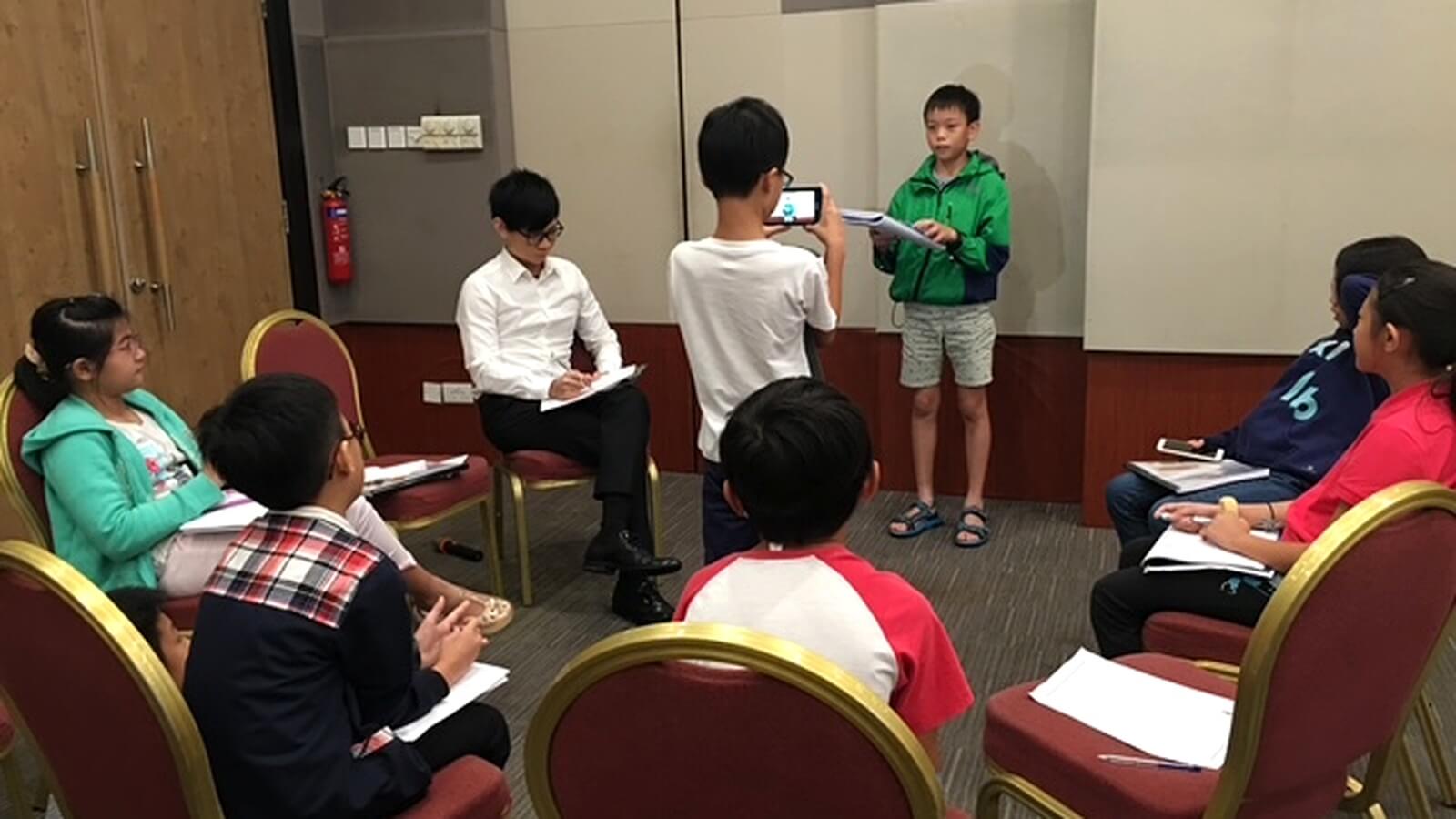
4. Use “Immediate Awareness and Correction”
One exercise we frequently use at Public Speaking Academy is something I call Immediate Awareness and Correction.
Suppose a student is speaking too softly.
Simply saying:
“Speak louder.”
tells the student what is wrong.
But it doesn't necessarily show them what right sounds like.
Instead, the trainer can pause the student and demonstrate an appropriate level of vocal projection.
The trainer's voice becomes an immediate reference point.
The child listens.
The child repeats the same section.
The trainer provides immediate feedback.
The child tries again.
The learning cycle becomes:
Awareness → Demonstration → Correction → Feedback → Quality Repetition
This is an important distinction.
Improvement doesn't come only from understanding intellectually what good public speaking looks like.
Children need to experience the correct behaviour themselves.
With sufficient quality repetition, the corrected behaviour becomes increasingly familiar and easier for the child to reproduce independently.
This is also why PSA's current Speech Excellence Programme for children aged 7–18 includes repeated speaking opportunities and trainer feedback rather than teaching public-speaking theory alone. The programme runs age-specific groups for ages 7–8, 9–12 and 13–18.
A real example: how Alice went from speaking one-to-one to presenting to her class
One student who stands out to me is Alice, whom I taught when she was in Primary 3.
When Alice first joined my class, she was very soft-spoken and did not dare to present in front of the other students.
So I didn't immediately insist that she stand before the entire class.
Instead, I invited her to stay back after class.
Her first presentation was delivered one-to-one, directly to me.
After each attempt, I deliberately pointed out what she had done well so that she could begin recognising her own strengths as a speaker.
We also worked on her vocal projection.
I used my own speaking volume as her reference point. I demonstrated an appropriate presentation voice, Alice tried it immediately, and I gave her feedback on the spot.
Gradually, her voice became stronger.
More importantly, so did her confidence.
Within four weeks, Alice progressed from being afraid to speak in front of her classmates to successfully presenting her speech before the entire class.
Alice's experience does not mean every shy child will become confident in four weeks.
That would be an irresponsible promise.
What her experience illustrates is something more useful:
The distance between “I can't do this” and “I just did this” can sometimes be crossed through a series of much smaller steps.
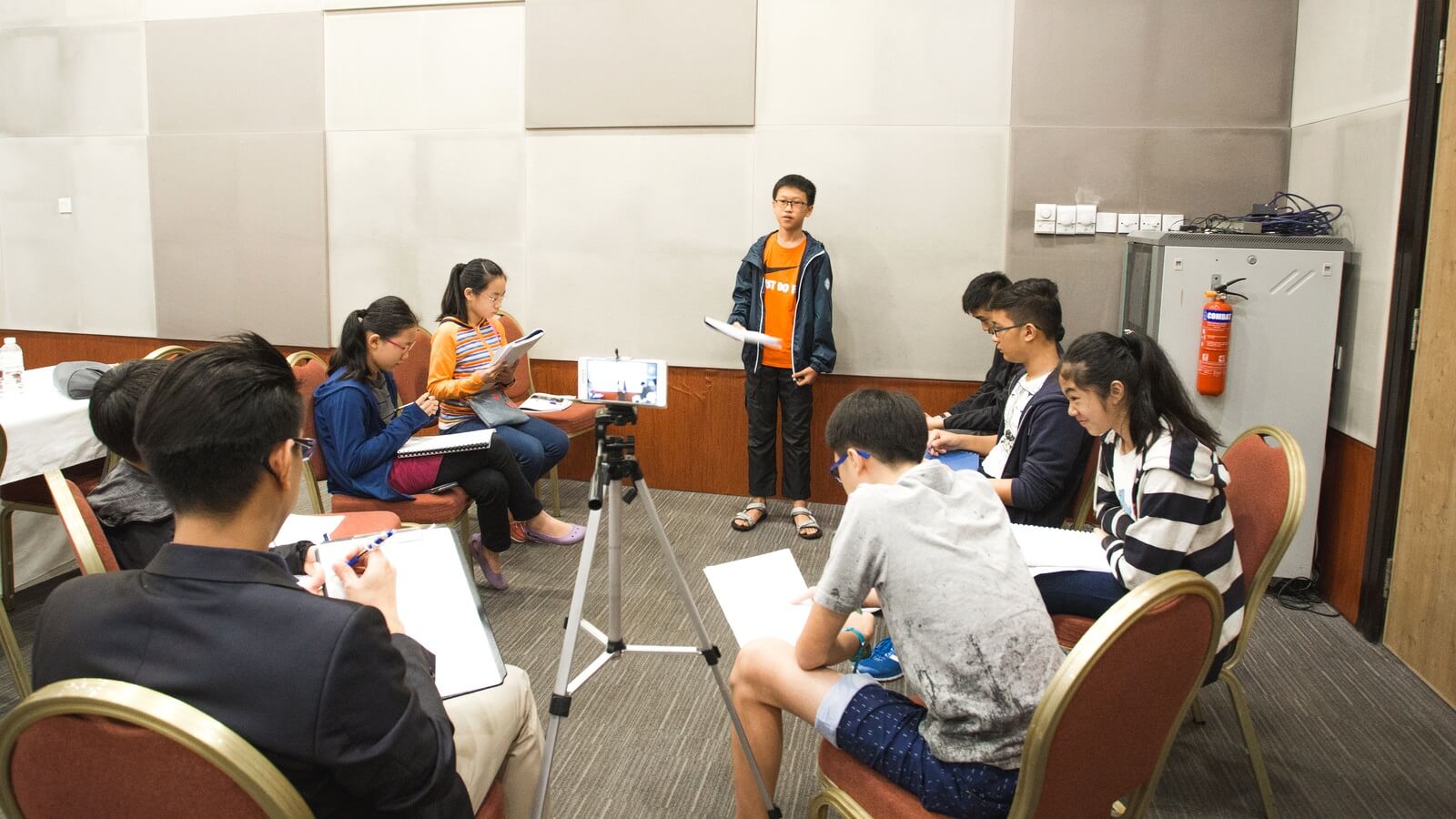
5. Practise public speaking at home — but don't turn home into an examination hall
Parents can help tremendously.
You do not need a podium, microphone or PowerPoint deck.
Try a short speaking activity during an ordinary family conversation.
Ask your child:
“What was the most interesting thing that happened in school today?”
Then ask them to explain why.
Or:
“If you could change one school rule, what would you change?”
Then:
“Why?”
And:
“What might someone who disagrees with you say?”
These questions build more than public-speaking confidence. They encourage children to form opinions, organise ideas and explain their reasoning.
For younger or especially shy children, you can make the exercise even simpler.
Ask them to tell a 30-second story.
Explain their favourite object.
Teach you something they learned at school.
Describe their favourite part of a holiday.
The objective isn't to produce a flawless speech.
It is to make expressing an idea aloud increasingly normal.
6. Don't make your child memorise every word
A memorised script can sometimes create the appearance of confidence.
Until something unexpected happens.
The child forgets one sentence.
Someone asks a follow-up question.
The teacher interrupts.
Suddenly, the entire mental script disappears.
This is something we also see in interview preparation. Students who depend excessively on model answers may sound polished when the anticipated question appears but struggle when an interviewer asks something unexpected.
Instead of memorising every sentence, help your child understand:
What is my main point?
What example will I use?
How will I explain it?
How will I conclude?
The child can then express the same idea naturally rather than trying to reproduce a paragraph word-for-word.
This becomes increasingly important as children encounter classroom discussions, oral examinations, interviews and impromptu situations where the exact question cannot always be predicted.
7. Teach a simple structure for moments when their mind goes blank
Sometimes a child lacks confidence because they genuinely don't know how to organise what they want to say.
Confidence-building therefore shouldn't focus only on psychology.
It should also build competence.
One simple structure PSA frequently teaches is Past–Present–Future.
If the topic is:
“How has technology changed the way students learn?”
a child can think:
Past: How did students learn previously?
Present: How do students learn now?
Future: How might learning change next?
I have taught versions of this kind of structural thinking for many years. Express to Impress includes Past–Present–Future among the structures speakers can have available when handling impromptu topics.
The principle is straightforward:
When children have a structure to fall back on, they have somewhere for their thoughts to go.
That can reduce the panic of staring at an audience thinking:
“I have absolutely no idea what to say.”
8. Give your child opportunities to speak outside training
A weekly public-speaking class can help.
But the class shouldn't become the only place where the child speaks.
Look for natural opportunities:
volunteering to answer a teacher's question;
explaining part of a group project;
ordering their own meal;
introducing themselves to someone new;
sharing an opinion during a family discussion;
taking a speaking role in a CCA;
presenting during school;
participating in an interview or competition when appropriate.
The aim isn't to turn childhood into one continuous presentation exercise.
😂
It is to allow communication skills to transfer into real life.
The importance of actual speaking experience has been part of my philosophy since long before PSA's present-day children's curriculum. In Express to Impress, I argued that improvement requires actual speaking practice rather than merely reading about speaking.
9. Help children review progress using more than “confidence”
Parents naturally ask:
“Is my child more confident now?”
But confidence can be difficult to measure.
Instead, look for a basket of indicators.
Speechcraft
Can they organise an answer more quickly?
Can they give examples instead of one-word responses?
Can they explain why they hold an opinion?
Voice
Are they more audible?
Is their speech clearer?
Are they rushing less?
Body language
Are they making more appropriate eye contact?
Is their posture more stable?
Are their gestures becoming more purposeful?
Adaptability
Can they answer an unexpected question?
Can they recover after forgetting a point?
Can they continue without relying completely on a script?
Confidence
Are they volunteering more frequently?
Are they willing to speak before a slightly larger audience?
Do they recover from mistakes more calmly?
This gives parents a much richer picture than asking whether their child has suddenly become “confident”.
How long does it take for a shy child to become more confident?
There is no responsible universal answer.
Some children demonstrate visible changes within weeks.
Others need months.
And progress is rarely perfectly linear.
A child might confidently deliver a prepared story this week and still freeze during an unexpected question next week.
That doesn't mean the training has failed.
They are different communication challenges.
After teaching public speaking for many years, I have found that progression can depend on factors such as:
the child's starting point, previous training, frequency of practice, opportunities to speak outside class, and consistency of application.
Based on PSA's own observations of students across a three-month training period, more than 90% demonstrated improvement in areas including speechcraft, organisation of thought and clarity of speech, while around 80% showed improvement in their use of body-language cues.
These figures represent PSA's internal training observations, not the findings of a controlled scientific study, and individual results naturally vary.
That distinction is important.
Our goal should not be:
“Make my child confident as quickly as possible.”
A better question is:
“Is my child making meaningful, observable progress?”
What if my child refuses to speak at all?
Don't immediately assume defiance.
Find out why.
Is the audience too large?
Are they afraid of making a mistake?
Have they had an embarrassing experience previously?
Do they not understand what they are supposed to say?
Are they struggling with the language of the task?
Are they comfortable speaking elsewhere but not in this particular environment?
Different causes require different responses.
A child lacking speech structure may need techniques.
A child afraid of an audience may benefit from a smaller starting point.
A child who has experienced repeated criticism may need successful experiences and more constructive feedback.
And there is an important boundary here.
Public-speaking coaching is not psychological or clinical treatment.
If a child's fear or social anxiety is intense, persistent, causes significant distress, or substantially interferes with ordinary school, family or social functioning, parents should consider discussing the situation with an appropriately qualified healthcare or mental-health professional rather than assuming that additional speaking practice alone is the answer.
Should I enrol my shy child in public speaking classes?
A good public-speaking programme can help if the learning environment matches the child's needs.
For a shy beginner, I would look beyond promises such as “Become confident!” and ask more practical questions:
Will my child actually get to speak?
Will the trainer give individual feedback?
Can challenges be adjusted according to the child's starting level?
Are children taught actual techniques as well as encouraged psychologically?
Does the programme provide repeated opportunities to apply those techniques?
Will feedback tell my child specifically what they did well and what to improve?
At PSA, our year-long Speech Excellence Programme (SEP) uses age-specific classes and combines communication techniques with repeated presentation practice and feedback. Parents who aren't sure whether the environment suits their child can begin with a trial in an ongoing class rather than committing blindly; current availability and terms should always be checked on the programme page.
For children aged 9–18 who prefer an intensive introduction during the school holidays, PSA also runs the 2-day S'Peak Performance Kids public speaking programme, which includes breakout practice and a final presentation showcase.
The programme matters.
But so does what happens between programmes.
A child who learns a technique on Saturday and finds an opportunity to apply it in school on Monday is beginning to turn a classroom skill into a life skill.
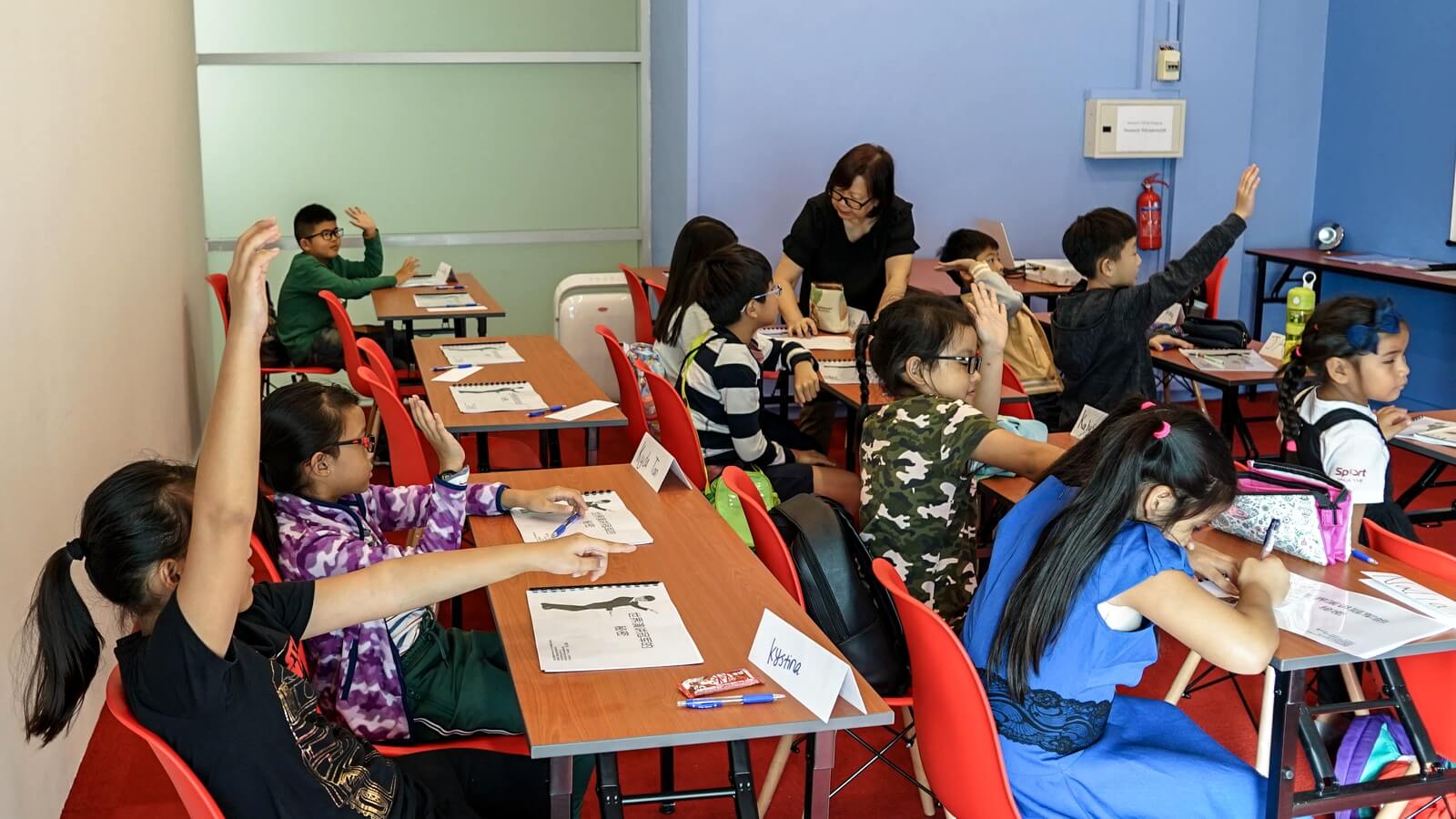
The goal isn't a fearless child
Parents sometimes imagine that confidence means eliminating nervousness completely.
I don't think that's a useful standard.
Even experienced speakers can feel nervous.
The more meaningful goal is to help a child learn:
“I can feel nervous and still speak.”
“I can forget something and recover.”
“I can make a mistake without the entire presentation being a failure.”
“I know what to do when I don't immediately know what to say.”
“I have done this before, and I can do it again.”
That's a very different kind of confidence.
It isn't bravado.
It's earned confidence.
And earned confidence grows through evidence.
A successful 30-second answer.
Then a one-minute presentation.
Then a presentation to three people.
Then five.
Then a classroom.
One experience becomes another.
From a shy teenager to a World Champion of Public Speaking
I certainly didn't know where my own first classroom presentation would eventually lead.
When I was younger, I was the student who avoided eye contact because I didn't want the teacher to call on me.
That journey eventually took me far beyond the classroom. I became Singapore's first World Champion of Public Speaking in 2016 and subsequently spent years coaching children and adults in communication.
But I wouldn't use that story to tell every shy child:
“You should become a World Champion too.”
That isn't the point.
The point is that where a child begins does not necessarily determine where they can go.
For one child, progress may mean competing on stage.
For another, it may mean raising their hand in class for the first time.
For another, speaking clearly during an oral examination.
For another, confidently answering an interviewer's follow-up question.
And for another, simply being able to stand before their classmates and say what they wanted to say.
Those victories may look different.
But they all begin with the same thing:
the next achievable step.
Frequently Asked Questions About Shy Children and Public Speaking
Can a shy child become a confident public speaker?
Yes. Shyness does not mean a child lacks the ability to communicate effectively. Public speaking consists of learnable skills such as speech organisation, vocal projection, eye contact, gestures and audience engagement.
For shy children, it can help to begin with manageable speaking situations and progressively increase the challenge while providing specific feedback and positive reinforcement.
Should I force my shy child to speak in front of people?
Simply forcing a highly uncomfortable child into a large speaking situation may not be the most constructive starting point.
Consider reducing the difficulty first — for example, presenting to a parent, trainer or small group — before progressively increasing the audience size.
The objective is still to challenge the child, but at a level where successful experiences can accumulate.
Is my child shy or introverted?
The two are not identical.
A shy child may want to speak or interact but feel inhibited or afraid in a particular situation. An introverted child may simply prefer quieter environments or need more time alone to recharge.
Introversion does not prevent someone from becoming an effective public speaker.
How can I practise public speaking with my child at home?
Keep practice short and conversational.
Ask your child to tell a short story, explain something they learned, give an opinion and support it with reasons, or present to family members.
As confidence increases, introduce unexpected questions and gradually increase the audience size.
Focus feedback on one or two specific behaviours rather than correcting everything simultaneously.
How long does it take for public speaking classes to improve a child's confidence?
There is no universal timeline.
Children begin at different levels and receive different amounts of practice outside class.
Look for observable improvements in speech organisation, clarity, vocal projection, body language, willingness to participate and ability to recover from mistakes rather than expecting a complete personality transformation within a fixed number of weeks.
About Darren Tay
Darren Tay is the Founder and Master Trainer of Public Speaking Academy and Singapore's first World Champion of Public Speaking, winning the Toastmasters International World Championship of Public Speaking in 2016.
He is also the author of Express to Impress and has trained students and working professionals in public speaking and communication skills.


