

If you search for a public speaking class for children in Singapore, you will quickly encounter some familiar promises.
Build confidence.
Improve presentation skills.
Learn to speak clearly.
Small classes.
Experienced trainers.
Personalised feedback.
These are all worthwhile qualities. But they do not necessarily tell you whether a particular programme is the right one for your child.
A shy child who is afraid to speak in front of classmates may require a very different training approach from an outgoing child who speaks confidently but rambles. A student preparing for a school interview has different needs from one who struggles with vocal projection. And a child who delivers a polished prepared speech may still freeze when asked an unexpected question.
So before asking, “Which public speaking class should I enrol my child in?”, there is an even more useful question:
“What does my child actually need help with?”
Darren Tay, Founder of Public Speaking Academy and the 2016 World Champion of Public Speaking, has coached children regularly since 2009, in addition to his work training adult speakers and professionals.
His advice to parents begins not with choosing a school, but with understanding the child.
“Different challenges require different approaches, so understanding the underlying gap is more useful than simply deciding that a child ‘needs public speaking classes.’” — Darren Tay
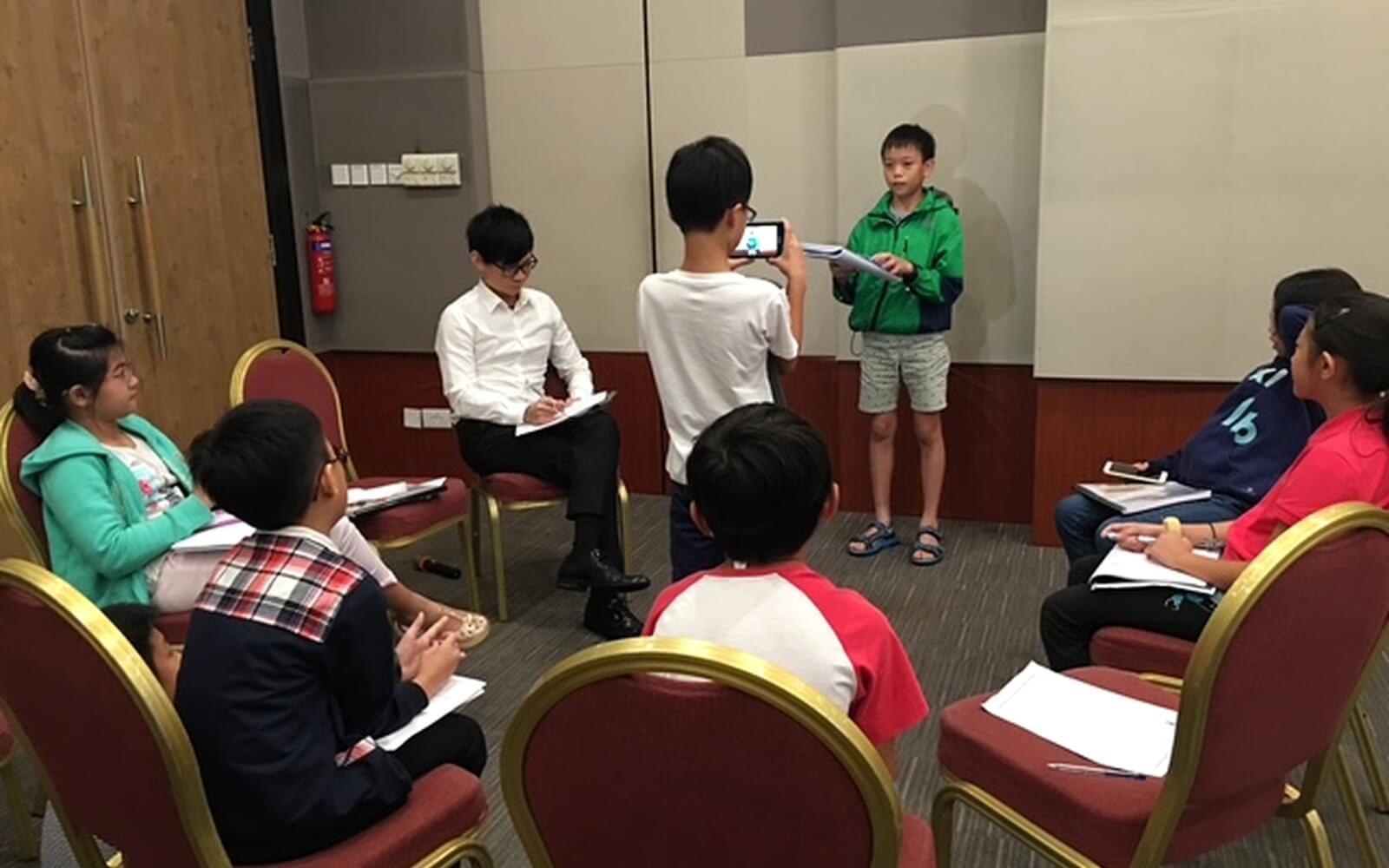
1. Start With the Outcome: Why Does Your Child Need Public Speaking Training?
“I want my child to become more confident” is one of the most understandable reasons for seeking public speaking lessons.
The problem is that confidence can mean many different things.
Darren recommends first identifying what you actually hope your child will become better at.
Is your child trying to:
feel less nervous when speaking in front of others?
express ideas more clearly during school presentations?
improve vocal delivery and body language?
organise answers more coherently?
prepare for an oral examination?
become more comfortable with interviews?
learn to answer unexpected questions?
develop impromptu speaking skills?
prepare for a public speaking competition?
These goals overlap, but they are not identical.
A child preparing for an interview, for example, needs more than confident delivery. He or she may need to listen carefully to questions, organise thoughts quickly, communicate personal experiences authentically and remain composed during unexpected follow-up questions.
In Darren's 2026 book Mastering Interview Questions, he makes a similar distinction: structured techniques provide something to rely on under pressure, but knowing a technique is not enough. Candidates need to practise answering aloud, simulate pressure, review their performance and receive feedback.
This is why parents should avoid choosing a programme purely because it broadly promises to “build confidence”.
First define the outcome. Then evaluate whether the training actually addresses it.
2. Diagnose the Gap: What Is Actually Holding Your Child Back?
Once you know the desired outcome, look at the child's current difficulty.
From Darren's experience, the obstacle could be:
Voice: speaking too softly, too quickly or monotonously.
Body language: limited gestures, weak eye contact or distracting movements.
Content: not knowing what to say.
Organisation: having ideas but struggling to structure them coherently.
Impromptu thinking: doing well when prepared but struggling with unexpected questions.
Nervousness: knowing what to do but finding it difficult in front of an audience.
Shyness: withdrawing or avoiding speaking situations altogether.
This distinction matters.
Imagine a child who gives long, disorganised answers. More encouragement to “be confident!” doesn't solve the underlying problem if the child actually needs a simple structure for organising ideas.
Similarly, a highly sociable child can still have weak presentation technique.
And an introverted child isn't automatically an unconfident speaker. As we discussed in our guide on helping a shy child become more confident in public speaking, the aim should not be to turn every quieter child into an extrovert. It is to help children communicate effectively when the situation requires it.
A useful way to think about it: Goal → Gap → Training
Before comparing programmes, ask:
What do we want our child to become better at?
What is currently preventing that?
Does this programme provide enough practice and feedback in that particular area?
The name of the course matters less than whether those three things line up.
3. Don't Forget Your Child's Capacity for Consistent Practice
There is another consideration parents sometimes overlook: time.
Public speaking is a skill.
Like other skills, it develops through repeated practice, application and feedback rather than through simply understanding a concept once.
Darren cautions that even an excellent programme may have limited impact if a child is already overloaded with activities, frequently misses lessons or has little opportunity to practise what has been taught.
That doesn't mean every child needs hours of public-speaking homework.
It means parents should think realistically about whether the programme's format fits the child's schedule and whether the child can participate consistently enough for learning to accumulate.
This principle appears throughout PSA's training philosophy: theory matters, but children also need opportunities to put that theory into practice.
4. Watch What Happens in the Classroom: Who Is Actually Doing the Speaking?
One of Darren's first criteria when evaluating a children's public speaking class is surprisingly simple:
How much opportunity do the children actually get to speak?
“Public speaking cannot be learnt simply by listening to a trainer explain techniques.” — Darren Tay
A trainer can deliver an entertaining 30-minute explanation of eye contact, gestures or vocal variety.
But the child hasn't practised eye contact, gestures or vocal variety simply by listening to it.
Students need opportunities to:
Learn → Stand Up → Speak → Receive Feedback → Try Again
This is an important distinction between a class that is merely about public speaking and a class in which children are actually learning to become speakers.
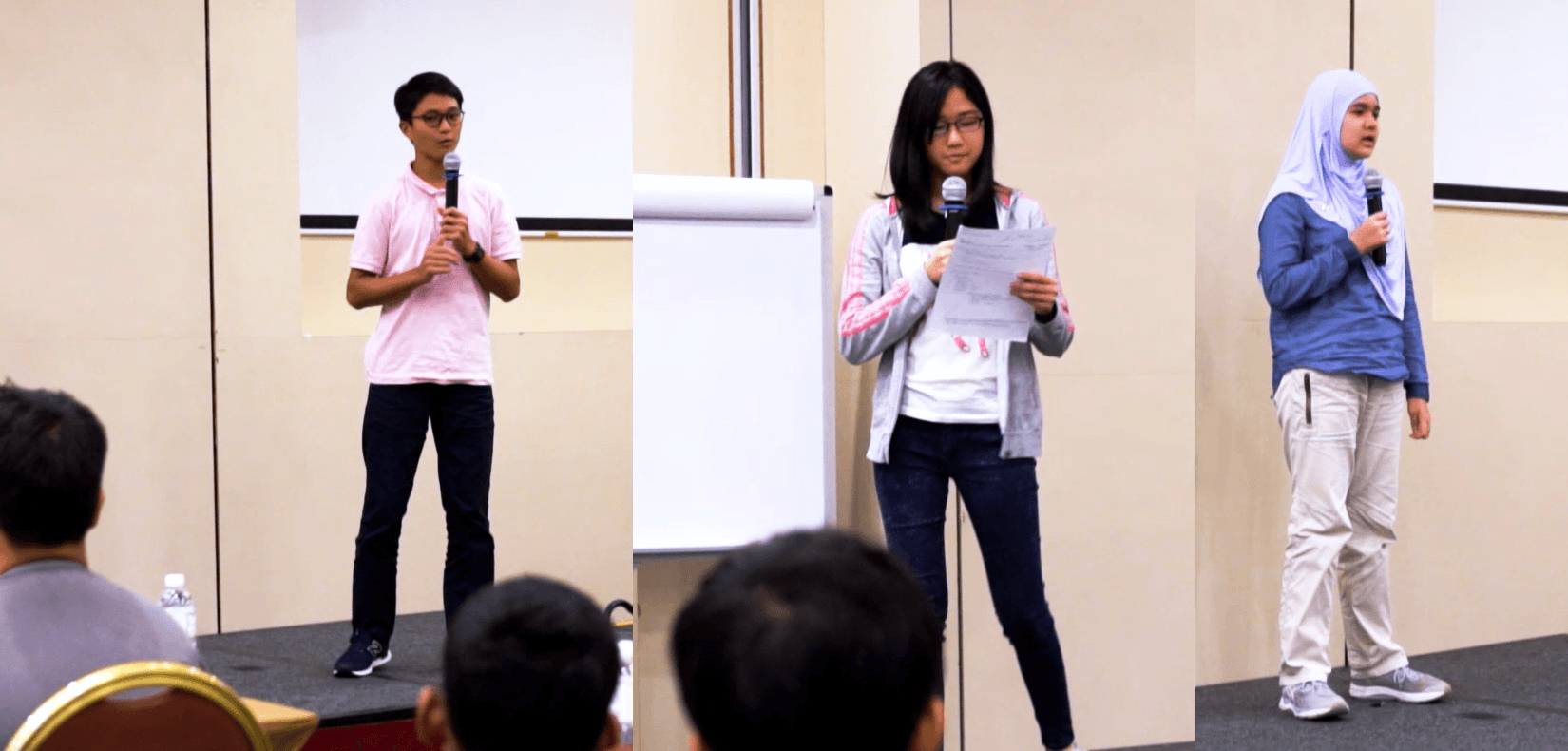
Does a smaller class automatically mean a better class?
Not necessarily.
Class size matters because it affects opportunities for participation and individual attention. But the raw number alone doesn't tell you how effectively the lesson is conducted.
A more useful question is:
“Given this class size and lesson duration, how does every child get meaningful opportunities to speak?”
A well-designed class should deliberately create speaking opportunities rather than allow a small number of naturally confident students to dominate.
5. Look Beyond “Personalised Feedback”: What Does the Feedback Actually Sound Like?
“Individual feedback” or “personalised feedback” appears frequently in descriptions of enrichment programmes.
Parents should go one step further.
Ask how that feedback is delivered.
Suppose a child finishes a speech and hears:
“Good job! Speak louder next time and use more gestures.”
That is technically feedback.
But compare it with a trainer who identifies where the child's volume dropped, demonstrates how one particular sentence should be projected, identifies an appropriate place for a gesture and asks the child to perform that section again.
Darren believes effective feedback should contain both strengths and areas for improvement, but it should also be specific enough for the child to act upon.
The trainer might identify:
the exact sentence where greater projection is required;
a word that could benefit from vocal emphasis;
where the child's pace became too fast;
where a purposeful pause could replace an “um”;
where a gesture could reinforce an important idea;
where eye contact was lost;
or where the child's speech structure became unclear.
The feedback should also remain encouraging.
Children need enough psychological safety to experiment, make mistakes and want to try again.
That balance matters. Feedback that is relentlessly positive may not produce improvement. Feedback that makes a child afraid to speak again defeats the purpose of the training.
6. A Good Trainer Should Demonstrate — Not Merely Describe
This is where the trainer becomes particularly important.
If a child is speaking too softly, Darren doesn't believe the correction should stop at:
“Speak louder.”
The trainer should be capable of demonstrating the appropriate projection, then allowing the child to reproduce it.
If a sentence lacks vocal variety, the trainer can deliver the same sentence using different emphasis, pacing or emotion, allowing the child to hear the difference before trying it.
This follows a pattern that appears repeatedly in PSA's coaching approach:
Observe → Identify → Demonstrate → Child Reproduces → Feedback → Repeat
In our previous article, we described a related process Darren uses as Immediate Awareness and Correction: instead of allowing an unhelpful speaking habit to continue unnoticed, the trainer helps the child become aware of it, demonstrates an alternative and provides an immediate opportunity to practise the correction.
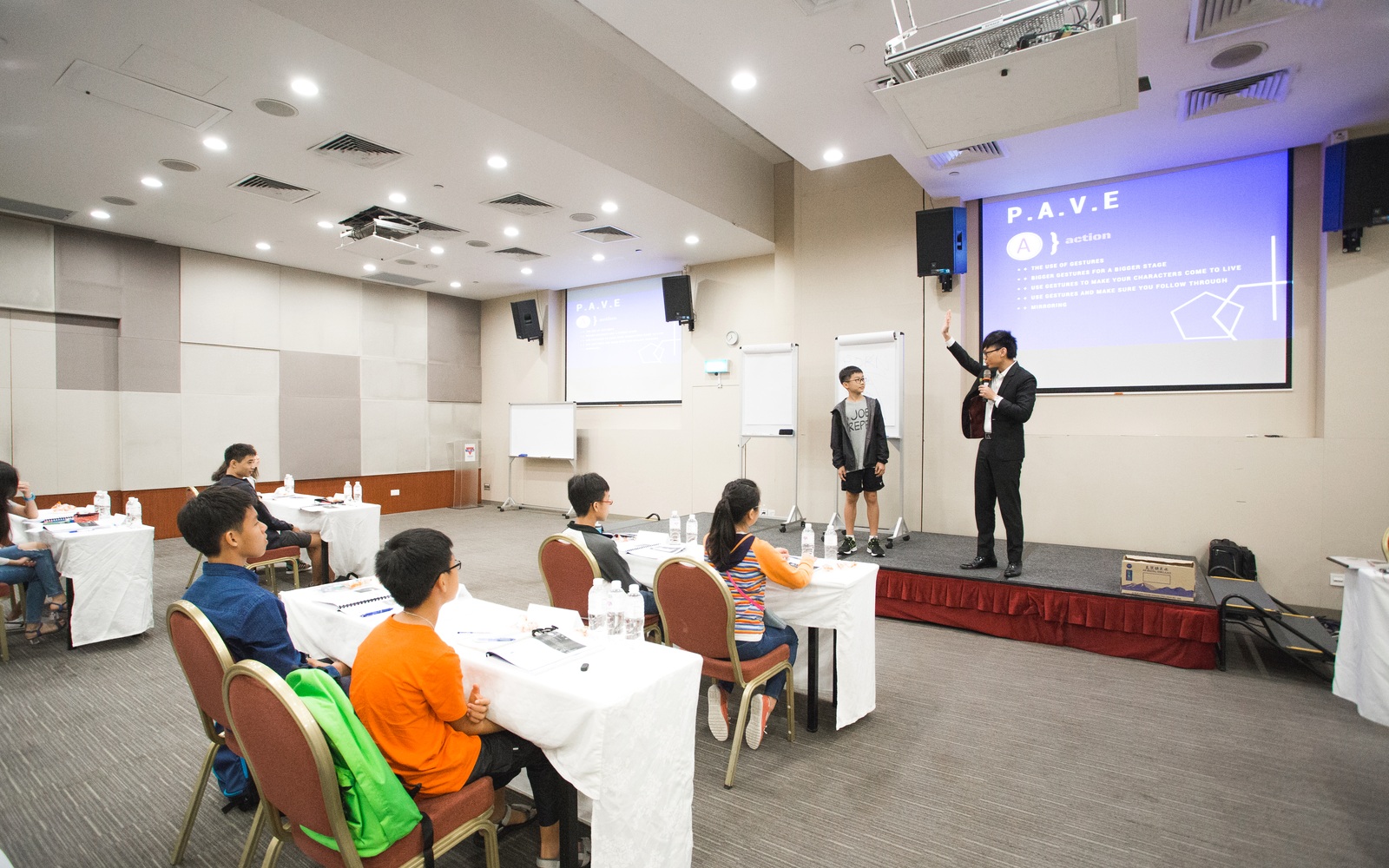
7. How Important Is the Trainer Compared With the Curriculum?
A structured curriculum matters.
But two trainers can teach the exact same lesson plan and create very different learning experiences.
According to Darren:
“Ultimately, a curriculum tells you what to teach, but the trainer determines how effectively that learning reaches the child.”
For children's public-speaking training, being an accomplished speaker is therefore not enough by itself.
A good trainer should also be able to:
explain concepts in language children understand;
engage students with different personalities;
create an environment where mistakes are acceptable;
recognise what a child is already doing well;
detect the particular behaviour limiting progress;
demonstrate the desired technique;
give specific and practical corrections;
and adjust the approach for different learners.
Public speaking contains many moving parts simultaneously: content, organisation, voice, body language, confidence and audience engagement.
An experienced trainer has to decide not only what is wrong, but also what is worth correcting first.
This is why parents evaluating a programme should ask who will actually teach their child's regular class, rather than looking only at the credentials of the academy's founder.
8. Symptom or Cause? Why Observation Matters
Darren remembers working with a student whose parent was concerned about the clarity of his speech and wondered whether there might be a more serious underlying issue requiring a different form of intervention.
Once Darren observed the child speaking, however, he noticed something more specific that could be addressed through public-speaking training.
The student used pause fillers — “um”, “uh” and similar sounds — very frequently while formulating his thoughts.
Those interruptions broke the flow of his sentences and made his speech sound less clear than it actually was.
So the training target changed.
Rather than simply telling the child to “speak more clearly”, Darren worked with him on:
becoming aware of his pause fillers;
organising thoughts before speaking;
and becoming comfortable using silence when he needed thinking time.
The lesson here is not that trainers should diagnose speech or medical conditions — those concerns may require an appropriately qualified professional.
It is that what we notice first may be a symptom rather than the underlying speaking behaviour causing it.
As Darren explains:
“What a parent notices at home may be a genuine symptom, but it may not always reveal the actual cause.”
That is why observation should come before prescription.
9. What Should Parents Expect From a Public Speaking Trial Class?
A trial lesson can be extremely useful — provided parents evaluate the right things.
First, don't expect a dramatic personality transformation after one class.
That isn't the purpose of a trial.
Darren views it primarily as an opportunity to determine whether the:
Trainer + Teaching Approach + Learning Environment + Child
...are a good fit.
At Public Speaking Academy, trial students in the regular Speech Excellence Programme for children and teens join an actual ongoing class, rather than a specially created demonstration lesson.
That allows the child to experience the normal learning environment: how lessons are taught, how existing students participate and how trainers give feedback. PSA's existing FAQ likewise describes its trials as live sessions within ongoing classes rather than standalone sales previews.
This concept isn't unique to PSA — other Singapore providers now also advertise trials within regular classes — which makes the quality of what happens during the trial more useful to evaluate than the mere existence of a trial itself. For example, SuperMinds currently describes its trial as the same regular 90-minute class its enrolled students attend.
Don't just ask: “Did you have fun?”
Enjoyment matters, especially for children.
But after a trial, Darren recommends asking questions such as:
“Did you feel comfortable speaking in the class?”
“What did the trainer say you did well?”
“What did the trainer ask you to improve?”
You can also ask:
“Can you show me one thing you learnt?”
The answers can reveal whether the child merely enjoyed an activity or actually experienced learning, application and feedback.
10. For a Shy Child, Look for Small Signals — Not an Overnight Transformation
Suppose your child enters the trial reluctantly, barely speaks and does not suddenly emerge 90 minutes later volunteering to deliver the next National Day Rally.
That doesn't necessarily mean the class failed. 😂
For a shy or initially resistant child, Darren recommends looking for smaller indicators.
Afterwards:
Are they less resistant to attending again?
Did they feel safe even when they made a mistake?
Did they feel encouraged by the trainer?
Can they identify something they did well?
Can they identify something they can improve?
Can they imagine returning the following week?
These indicators matter because improvement in public speaking is usually progressive.
This echoes something Darren observed in our earlier article on shy children: successful speaking experiences gradually become evidence to the child that “they can do it.”
A useful trial-class question therefore isn't only:
“Was this a good class?”
It is:
“Is this an environment in which my child is willing and able to keep learning?”
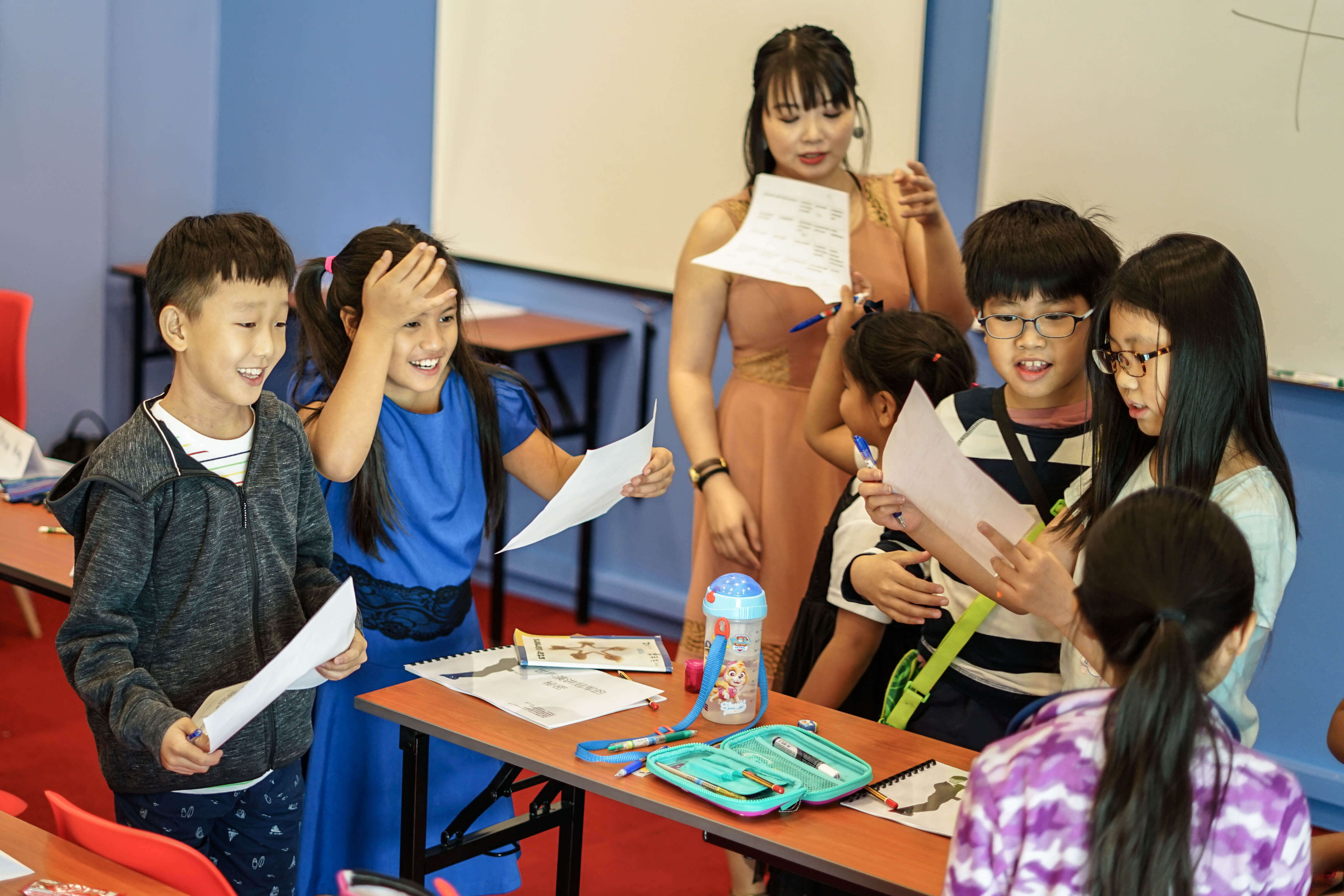
11. Make Sure the Skills Transfer Beyond the Public Speaking Classroom
There is little point in producing a child who performs beautifully during public-speaking class but cannot use those communication skills anywhere else.
Parents should therefore ask how the curriculum connects speaking techniques with situations children genuinely encounter.
Depending on the child, that might include:
answering a teacher's question in class;
presenting a school project;
expressing an opinion clearly;
speaking during an oral examination;
participating in an interview;
handling an unexpected follow-up question;
competing in a speech competition;
communicating with unfamiliar adults;
or simply explaining an idea coherently during everyday conversation.
This is also why the type of programme matters.
A child seeking long-term development across different speaking genres may benefit from regular progressive training. PSA's Speech Excellence Programme, for example, exposes students to areas such as storytelling, impromptu speaking, interviews, oral communication, debate and persuasive speaking over time.
A child who needs an intensive introduction during the school holidays may instead be better suited to a shorter programme such as the S'Peak Performance Kids School Holiday Programme.
And a child specifically preparing for an interview may need targeted interview-skills training rather than a general confidence-building programme.
Different child. Different goal. Different training need.
12. Ask How Your Child's Progress Will Be Tracked
Public-speaking progress is not always captured by a single test score.
A child can improve in several dimensions at different speeds.
Darren's broader coaching approach uses what we have previously described as a Basket of Indicators.
Depending on the child and training objective, progress might include:
needing less preparation time;
organising answers more coherently;
speaking with fewer distracting pause fillers;
projecting more clearly;
maintaining stronger eye contact;
using gestures more purposefully;
becoming more comfortable with impromptu questions;
expressing opinions with greater depth;
speaking to progressively larger audiences;
or volunteering to speak more readily.
Notice that “more gestures” isn't automatically better, nor is “speaking louder” always the objective.
Progress should be connected to the child's starting point and intended outcome.
That brings us back to the beginning:
If nobody clearly understands what the child needs to improve, it becomes difficult to determine whether the programme is working.
Darren Tay's 5 Questions to Ask Any Public Speaking School in Singapore
We asked Darren to imagine that a parent approached him before enrolling anywhere — including at Public Speaking Academy.
What should that parent ask?
Here are his five questions:
1. Who will be teaching my child, and what experience does the trainer have in teaching children?
Don't look only at the founder, curriculum designer or most famous person on the website.
Find out who actually conducts your child's lessons and whether that trainer has experience teaching children, not merely speaking publicly.
2. What is the class size, and how does every child get enough opportunities to speak?
The second half of this question is arguably more important than the first.
A number doesn't tell you how class time is used.
Ask how the programme makes sure quieter students receive meaningful speaking opportunities too.
3. How will my child get individual feedback?
Then dig deeper.
Is the feedback specific? Does it identify strengths as well as areas for improvement? Does the trainer demonstrate corrections? Does the child have an opportunity to apply the feedback?
4. How do you track my child's progress over time?
Look for more than whether the child appears happy after class.
Ask what the trainer watches for and how improvement is recognised across content, organisation, delivery and confidence.
5. Beyond learning techniques, how does your programme help children apply their speaking skills in real situations?
Ask how classroom learning connects with school presentations, interviews, competitions and everyday communication.
That is ultimately where communication skills need to work.
A Practical Checklist Before You Enrol
You don't need to find a public-speaking programme that has the flashiest classroom, longest list of techniques or most impressive marketing claims.
You need one that fits your child.
Before enrolling, check whether you can answer these questions:
Goal: What do I actually want my child to become better at?
Gap: What appears to be holding my child back right now?
Trainer: Who will teach my child, and can that person teach, observe and correct children effectively?
Practice: Will my child actually spend meaningful time speaking?
Feedback: Will the feedback be individual, specific and actionable?
Application: Will my child practise using these skills in relevant real-world situations?
Progress: How will we recognise improvement over time?
Consistency: Can my child realistically participate often enough for the training to accumulate?
Fit: Does my child feel sufficiently safe, supported and challenged to keep learning?
If you're comparing several public-speaking classes in Singapore, take this checklist with you.
And ask the providers.
Including us.
The Right Public Speaking Class Should Help Your Child Progress — Not Become Someone Else
Ultimately, the purpose of children's public-speaking training isn't to manufacture the same type of speaker.
A shy child doesn't have to become the loudest person in the room.
An introvert doesn't need to become an extrovert.
A naturally confident child may need structure more than courage.
A polished prepared speaker may need to become more adaptable when the script disappears.
And a child whose speech sounds unclear may, as Darren's student demonstrated, need help with thought organisation and pause fillers rather than simply being told to “speak more clearly”.
The right programme begins by understanding where the child is now, identifies what is getting in the way, and provides enough targeted practice, feedback and application to help the child move forward.
Public speaking isn't about producing a perfect speech.
It is about developing a progressively more capable communicator.
Frequently Asked Questions About Choosing Public Speaking Classes for Kids in Singapore
What should I look for in a public speaking class for my child?
Look beyond the course description. Consider the trainer's experience teaching children, class size and actual speaking opportunities, quality of individual feedback, how progress is tracked, and whether students apply techniques through presentations, interviews, impromptu speaking or other real situations.
Most importantly, make sure the programme addresses your child's particular goal and current speaking gap.
Are small public speaking classes always better for children?
Smaller classes can make individual attention and speaking opportunities easier, but class size alone doesn't guarantee quality.
Ask how the lesson is structured so that every child actually speaks, receives feedback and has opportunities to apply corrections.
Should my child attend a trial public speaking class first?
A trial can be useful for assessing the trainer, teaching approach, participation, feedback and overall fit.
Don't expect one lesson to transform your child's confidence. Instead, determine whether your child feels sufficiently comfortable and supported to continue learning consistently.
My child is shy. Should I enrol them in public speaking classes?
A shy child can benefit from public-speaking practice when the environment and level of challenge are appropriate.
Rather than immediately forcing the child onto a large stage, gradual speaking experiences can help build familiarity and successful experiences. You can read more in our guide to helping shy children build public-speaking confidence.
If a child's distress is severe, persistent or significantly affects everyday functioning, public-speaking coaching should not be treated as a substitute for appropriate professional support.
How long does it take for a child to improve at public speaking?
There is no universal timeline.
A child's starting point, training goal, attendance, opportunities to practise outside class and responsiveness to feedback all matter. Rather than expecting an overnight transformation, look for progressive changes across a basket of indicators such as organisation, vocal delivery, body language, impromptu thinking and willingness to speak.
About Darren Tay
Darren Tay is the Founder of Public Speaking Academy and the 2016 World Champion of Public Speaking. He has trained speakers across different ages and professional backgrounds and has coached children regularly since 2018.
He is also the author of Express to Impress (2012) and Mastering Interview Questions (2026), the latter focusing on structured approaches to personal-disclosure, hypothetical, forecast, organisation-based, current-affairs, pressure, pitching and group-interview questions. The book describes interview skills more broadly as communication skills that transfer into situations such as pitching, negotiation, networking, meetings and conflict resolution.
At Public Speaking Academy, our aim is not simply to teach children what good public speaking looks like, but to give them repeated opportunities to understand, practise, receive feedback, correct and apply their communication skills.


