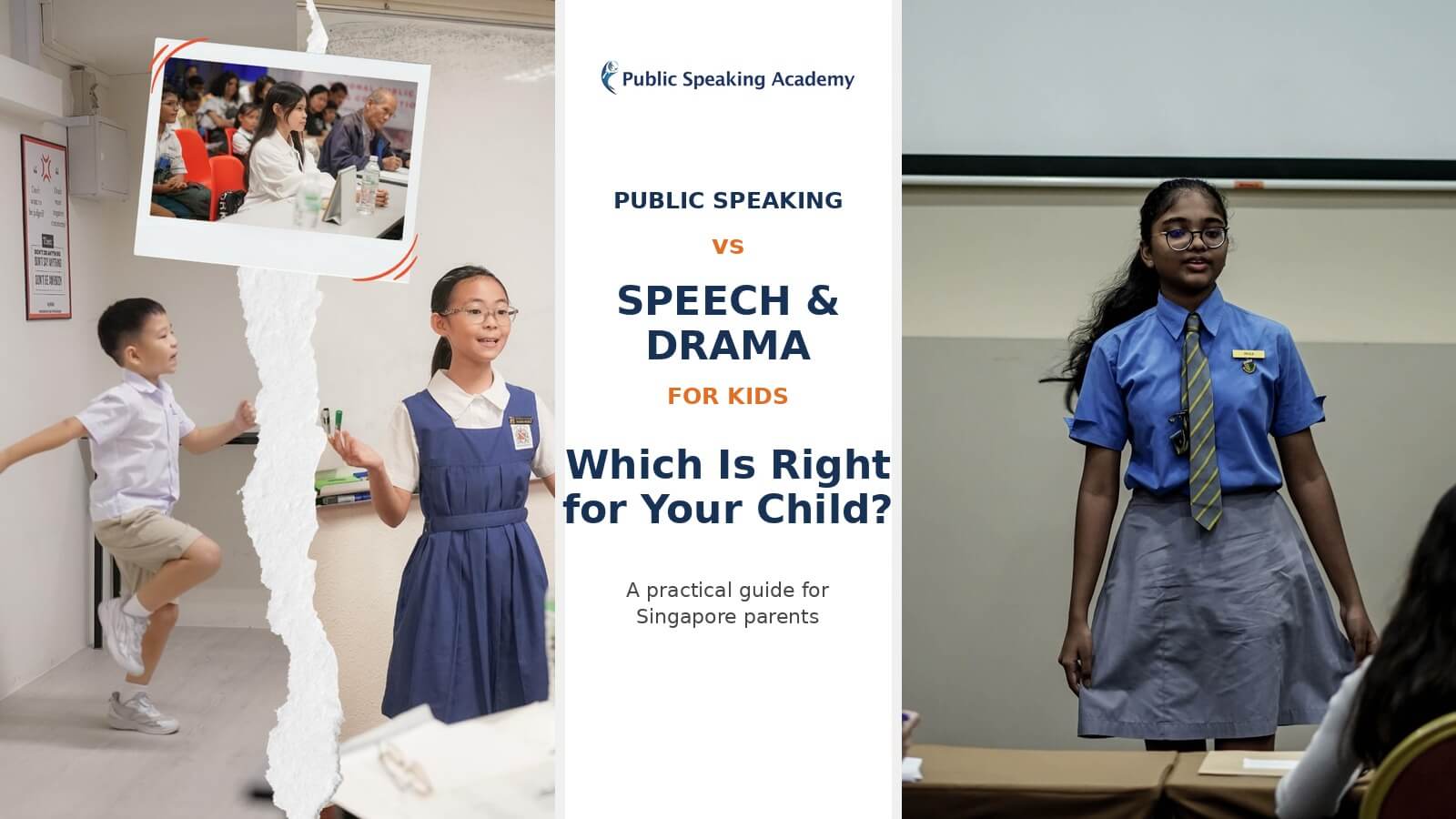
If your child is shy, struggles to speak up in class, or needs greater confidence communicating with others, you may have considered enrolling him or her in either Speech & Drama or Public Speaking classes.
At first glance, the two can look remarkably similar.
Children may practise vocal projection. They may learn body language, facial expressions and storytelling. They may stand in front of an audience. And both can help children become more comfortable expressing themselves.
So, what is actually the difference between Speech & Drama and Public Speaking — and which is better for your child?
According to Darren Tay, Founder of Public Speaking Academy and the 2016 World Champion of Public Speaking, the most useful question is not which programme is better.
It is:
What does your child need to be able to communicate?
A child who loves imaginative play, acting, characters and poetry may thrive in Speech & Drama. A child who needs to organise his or her own thoughts, answer unexpected questions, explain opinions, handle interviews or make presentations may benefit more directly from Public Speaking training.
And for some children, the answer may be both.
Here's how parents can tell the difference.
What Is the Main Difference Between Speech & Drama and Public Speaking?
There is genuine overlap between the two.
Both can help children develop:
Confidence in front of others
Vocal projection and expression
Body language
Storytelling ability
Audience engagement
Greater comfort performing or presenting
The difference becomes clearer when we consider what the child is being trained to communicate.
Darren explains:
“Speech & Drama often involves bringing a character, text, poem or script to life. Public Speaking focuses more heavily on helping children develop, organise and communicate their own ideas to an audience.”
That distinction is important.
In Speech & Drama, a child might ask:
How can I bring this character or text to life?
In Public Speaking, the questions are more likely to include:
What do I think?
What is my main message?
Why do I believe this?
What reasons or examples can I give?
How should I organise these ideas?
How do I respond if someone asks me something unexpected?
The child isn't merely learning how to deliver a message.
He or she increasingly has to create and organise the message too.
Speech & Drama and Public Speaking Can Train Similar Skills for Different Purposes
Consider something as simple as vocal variety.
A child performing a dramatic scene might alter pitch, pace, volume and emotion to portray a character or create a particular dramatic effect.
A child delivering a presentation may use those same vocal tools, but the purpose is different: to emphasise an important idea, make an explanation easier to follow or persuade an audience.
The same applies to gestures and facial expressions.
As Darren puts it:
“In Public Speaking, vocal variety and body language are not simply about being expressive; they should help the speaker communicate an idea more effectively.”
This is why evaluating children's communication skills solely according to whether they appear confident or expressive can sometimes be misleading.
A child may be a wonderfully expressive performer and still have another communication skill to develop.
A Confident Performer Is Not Automatically a Confident Public Speaker
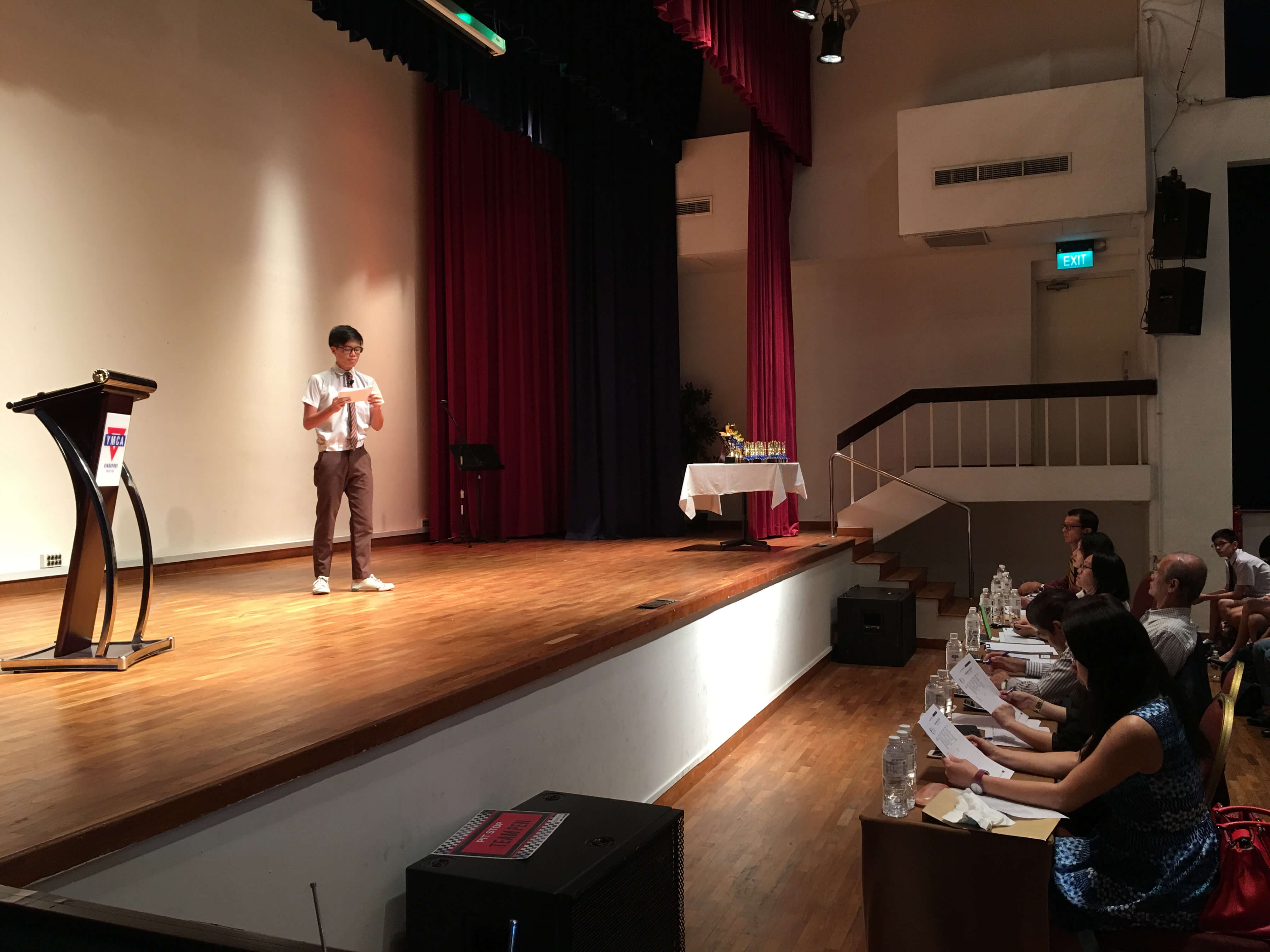
One misconception Darren has encountered is the assumption that confidence on stage automatically means strong public-speaking ability.
It doesn't necessarily.
Darren has coached children who were expressive and confident when they knew exactly what they were supposed to say.
Give them prepared material and they could deliver it comfortably.
But remove the script and ask:
“What do you think?”
Suddenly, a very different challenge appeared.
Some became considerably less certain — even though they weren't afraid of standing in front of an audience.
Why?
Because stage confidence was not actually the problem.
The challenge was generating ideas, organising those ideas quickly and expressing them coherently without relying on memorisation.
That distinction matters because parents can otherwise end up trying to solve the wrong problem.
A child doesn't necessarily need more confidence.
The child might need better thinking and communication tools.
Try the “Script Removed” Test
Here is a simple way for parents to think about the difference.
Imagine two situations.
Situation A: Prepared Communication
Your child knows what to say.
Perhaps there is a script, poem, story or prepared presentation. Your child has had time to practise it and knows approximately what comes next.
The principal challenge is delivering that material effectively.
Situation B: Unprepared Communication
Now remove the script.
Ask:
“What is one rule at school you would change, and why?”
Or:
“Would you rather work in a team or independently?”
Or simply:
“What did you think about what your teacher said today?”
Your child now has to:
Listen → Understand → Think → Organise → Respond
There is no predetermined answer to perform.
This doesn't mean Situation B is somehow superior to Situation A. They require overlapping but different abilities.
However, if a child is comfortable in the first situation and repeatedly struggles in the second, that tells us something useful about where the child's next communication gap may lie.
Speaking Without a Script Is a Skill That Can Be Learnt
Parents sometimes assume that certain children are simply “naturally quick thinkers”.
Certainly, children differ in temperament, experience and how quickly they formulate responses.
But spontaneous speaking can also be trained systematically.
Darren explains:
“Speaking without a script is itself a skill that can be learnt rather than something you either naturally can or cannot do.”
At Public Speaking Academy, a child does not necessarily begin by being given a complicated topic and being told to deliver a long impromptu speech immediately.
Training can be progressive.
Start with a simple question.
Teach the child to:
State a Point → Explain It → Give an Example
Once that becomes more familiar, progressively introduce more challenging questions and speaking situations.
Frameworks such as PEEL — Point, Explanation, Example, Link — can give children a mental roadmap for organising what they want to say.
For other topics, children can learn structures such as Past–Present–Future to arrange ideas chronologically.
The purpose of a framework isn't to give the child another script to memorise.
It gives the child a structure within which to think.
That distinction is crucial.
Why Does This Matter Outside a Public Speaking Class?
Because everyday life rarely provides children with a script.
Consider what happens when:
A teacher asks an unexpected question.
An examiner asks a follow-up question during an oral examination.
An interviewer asks something the child didn't prepare for.
A classmate challenges the child's opinion during a discussion.
A student leader has to explain an idea to classmates.
An adult asks the child a question during an ordinary conversation.
Even a child who has prepared an excellent presentation may subsequently hear:
“That's interesting. Why do you think that?”
Now the prepared speech is over.
The child has to listen, process and respond in real time.
Darren has observed the same phenomenon in presentations and competitions: a child can appear polished delivering prepared material, yet display a very different level of confidence and organisation when answering a question afterwards.
This is why children benefit from opportunities to practise both prepared and impromptu communication.
The ultimate objective is not merely to speak effectively when everything has been rehearsed.
It is also to communicate when the child doesn't know beforehand exactly what he or she is going to say.
So, Is Speech & Drama Better for Some Children?
Absolutely.
Parents do not need to view Speech & Drama and Public Speaking as competing activities where one must universally be better than the other.
A younger child who loves:
Imaginative play
Acting and characters
Poetry
Dramatic storytelling
Creative expression
may thoroughly enjoy Speech & Drama.
Darren says:
“If that is what the child enjoys and needs at that stage, I would certainly encourage it.”
That is an important consideration.
An enrichment activity should not merely look impressive on a timetable. It should serve the child's present interests, developmental needs or communication goals.
Public Speaking becomes particularly relevant when the objective shifts towards helping children communicate their own thinking.
Can your child answer a question without memorising the answer?
Can your child explain an opinion and give reasons?
Can your child organise a presentation independently?
Can your child respond when the conversation moves in an unexpected direction?
Those are different communication demands.
Can a Child Benefit From Both Speech & Drama and Public Speaking?
Yes.
The skills are not mutually exclusive.
A child who develops expressiveness, creativity and stage comfort through Speech & Drama may bring those abilities into Public Speaking.
Public Speaking training can then complement them by developing areas such as:
Idea generation
Speech organisation
Impromptu speaking
Persuasive communication
Interview responses
Listening and responding
Explaining personal opinions
Audience adaptation
Similarly, a child with strong analytical and organisational abilities may benefit from developing greater expressiveness and performance confidence.
The decision should therefore not be:
“Which activity should my child do forever?”
A more useful question is:
“What does my child need at this stage?”
A child's communication needs can evolve.
“My Child Already Does Speech & Drama. Does He or She Still Need Public Speaking?”
Darren's first response would not be to recommend another programme.
He would first ask:
What do you want your child to improve?
Then look at what the child can already do.
For example:
Can your child confidently present something prepared?
Can your child organise his or her own ideas?
Can your child answer unfamiliar questions?
Can your child explain an opinion with reasons and examples?
Can your child communicate confidently without memorising every sentence?
These answers tell us considerably more than simply knowing which enrichment programme the child already attends.
If the child is already a confident performer but struggles with spontaneous communication, idea organisation or speaking as himself or herself, Public Speaking can complement Speech & Drama very well.
But there is another possibility that parents shouldn't overlook:
The child may not currently need another class at all.
As Darren explains:
“If the child’s present interests and developmental needs are already being met, I would not recommend additional training simply for the sake of attending another class.”
The decision should come back to the specific skill the child needs to develop.
This is the same principle parents can use when choosing the right public speaking class for their child:
Start with the goal. Identify the gap. Then choose the training.
Not the other way around.
What If My Child Is Shy or Introverted?
This introduces another common misconception.
Public Speaking is not about turning introverted children into extroverts.
Nor is the objective simply to make a quiet child louder.
Darren notes:
“A quieter or more introverted child can become a very effective public speaker without becoming theatrical or changing his or her personality.”
Shyness and introversion are also not identical.
A child may be shy because speaking in front of others currently creates discomfort or fear. An introverted child, meanwhile, may simply prefer quieter environments or require more time alone to recharge.
Neither automatically determines how capable the child can become as a communicator.
For a shy child, the better approach may be progressive: begin with smaller, lower-pressure speaking situations and gradually increase the challenge as successful experiences accumulate.
We explore this process in greater detail in our guide on helping a shy child become more confident in public speaking.
The aim isn't personality replacement.
It is communication development.
Public Speaking Is Not Simply About Making Children Louder
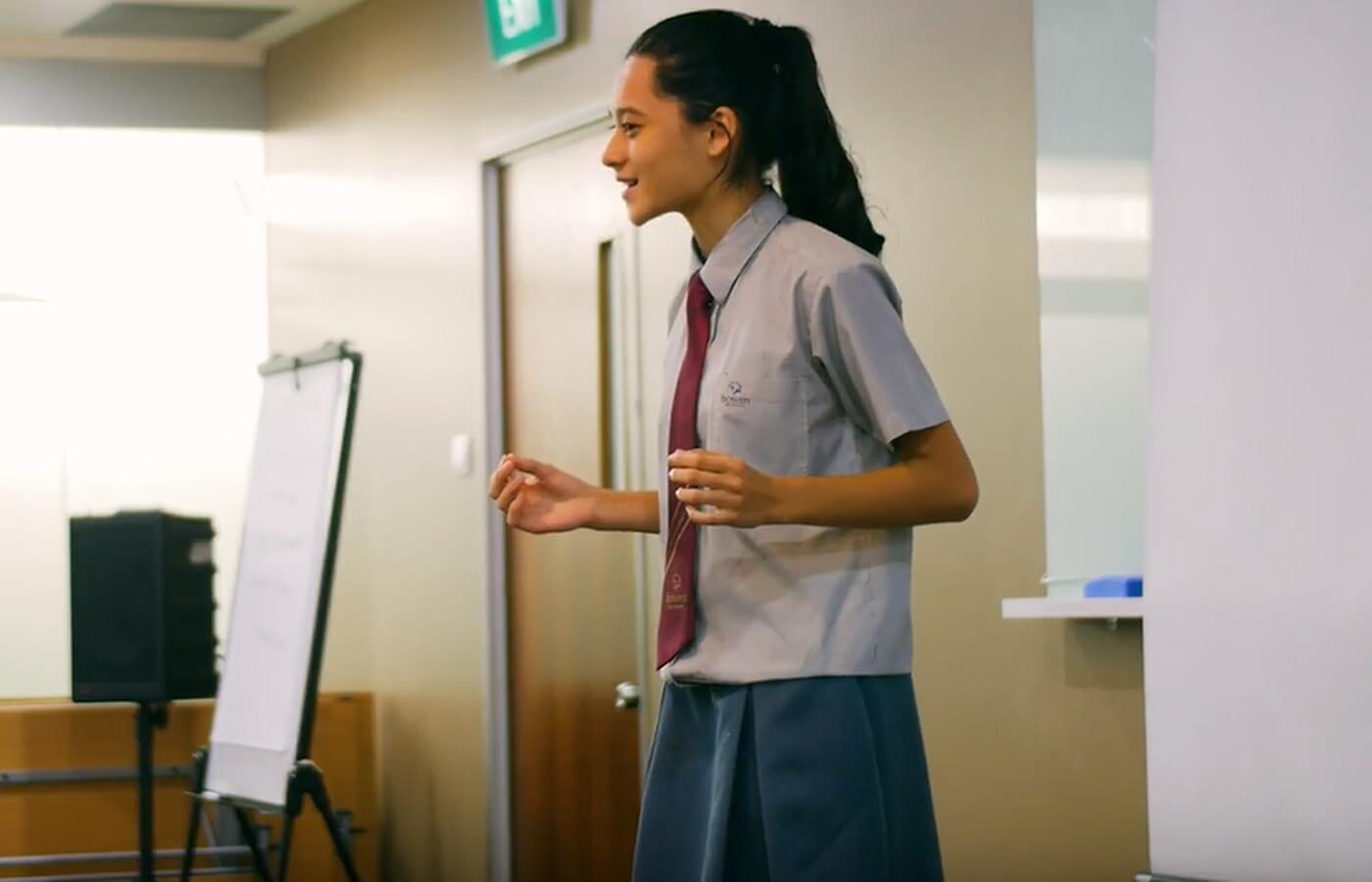
A child can project loudly and still struggle to explain an idea.
A child can use enormous gestures and still lack structure.
A child can appear highly confident and still ramble when answering an unfamiliar question.
That is why Public Speaking training should go beyond surface-level performance.
Darren's objective is to help children:
Think more clearly → Organise ideas → Communicate with purpose → Adapt to different audiences and situations
Delivery remains important.
Children can develop eye contact, vocal variety, gestures, facial expressions, posture and stage presence.
But these tools should serve the message.
A useful way to think about it is:
What do I want to say? → How should I organise it? → How can I deliver it effectively?
Strong communication requires all three.
7 Questions Parents Can Ask Before Choosing Between Speech & Drama and Public Speaking
Instead of choosing according to the name of the programme, observe your child and ask:
1. Does my child enjoy performing characters, stories and prepared material?
If this is where your child's interest currently lies, Speech & Drama may be an excellent fit.
2. Can my child communicate confidently when there is no script?
Try asking an unfamiliar but age-appropriate question.
Don't judge the opinion itself. Observe whether your child can formulate and organise an answer.
3. Can my child explain why he or she thinks something?
Moving from:
“I think X.”
to:
“I think X because… For example…”
is an important communication skill.
4. Can my child organise a presentation independently?
A child may deliver material beautifully once it has been prepared for him or her, but creating the presentation introduces a different challenge.
5. What happens when someone asks a follow-up question?
This is one of the clearest tests of adaptive communication.
Does your child listen to the actual question? Pause to think? Give a relevant answer? Explain the reasoning?
6. Where does my child actually need these skills?
Perhaps the immediate goal is:
an oral examination, a school presentation, an interview, a competition, student leadership, classroom participation, everyday confidence or simply clearer communication.
The real-world goal should influence the training choice.
7. Does my child actually need another programme right now?
Sometimes the answer is no.
More classes do not automatically mean more development.
Consider your child's existing activities, interests, workload and opportunities to practise.
The right training should address an identifiable need rather than simply occupy another slot in the weekly calendar.
If Public Speaking Is the Gap, What Should Parents Look For?
Once parents determine that Public Speaking is the more relevant skill area, the next question becomes how it is taught.
Children need opportunities to actually speak.
They should practise prepared and spontaneous communication, receive specific feedback, understand what they did well and know what to improve next.
A trainer should be able to demonstrate effective speaking rather than merely describe it.
And children need repeated opportunities to apply what they have learnt.
At Public Speaking Academy, our children's programmes therefore combine communication techniques with hands-on speaking practice and individual feedback.
For children looking for regular, longer-term development, the Speech Excellence Programme for students aged 7–18 covers different communication genres including storytelling, impromptu speaking, interviews, persuasive speaking, oral communication and presentations.
For families looking for a shorter intensive programme during the school holidays, the S'Peak Performance Kids Holiday Programme provides concentrated practice across areas including stage confidence, presentations, impromptu speaking, interviews and persuasive communication.
The programme format, however, should come after identifying the child's goal and communication gap.
The Best Choice Depends on the Child — Not the Label
Speech & Drama and Public Speaking share useful territory.
Both can help children become more expressive, comfortable and confident communicating in front of others.
But confidence itself is only one part of effective communication.
A child may be confident performing someone else's words yet struggle to organise his or her own.
Another child may be quiet by nature yet become exceptionally clear, thoughtful and persuasive when communicating an idea.
So rather than asking:
“Is Public Speaking better than Speech & Drama?”
ask:
“What can my child do comfortably today — and what communication skill does he or she need next?”
For some children, the answer will be Speech & Drama.
For others, Public Speaking.
For some, both at different stages.
And for others, their present development may already be well served without adding another enrichment programme.
Darren summarises the real objective best:
“Ultimately, I am less interested in whether a child can simply ‘perform confidently’ and more interested in whether that child can stand up, think independently and communicate an idea that genuinely belongs to him or her.”
That is a much bigger skill than simply being comfortable on a stage.
It is the ability to think — and communicate that thinking to another human being.
Frequently Asked Questions
Is Speech & Drama the same as Public Speaking for children?
No, although the two have overlapping skills. Both may develop confidence, vocal projection, body language and audience engagement. Speech & Drama often focuses on bringing characters, scripts, poems or stories to life, while Public Speaking places greater emphasis on developing, organising and communicating the child's own ideas.
Is Public Speaking or Speech & Drama better for a shy child?
Neither is automatically better simply because a child is shy. The right choice depends on the child's interests, source of discomfort and communication goals. Some children may enjoy the imaginative and character-based environment of Speech & Drama, while others may need progressive practice communicating their own ideas in increasingly challenging speaking situations.
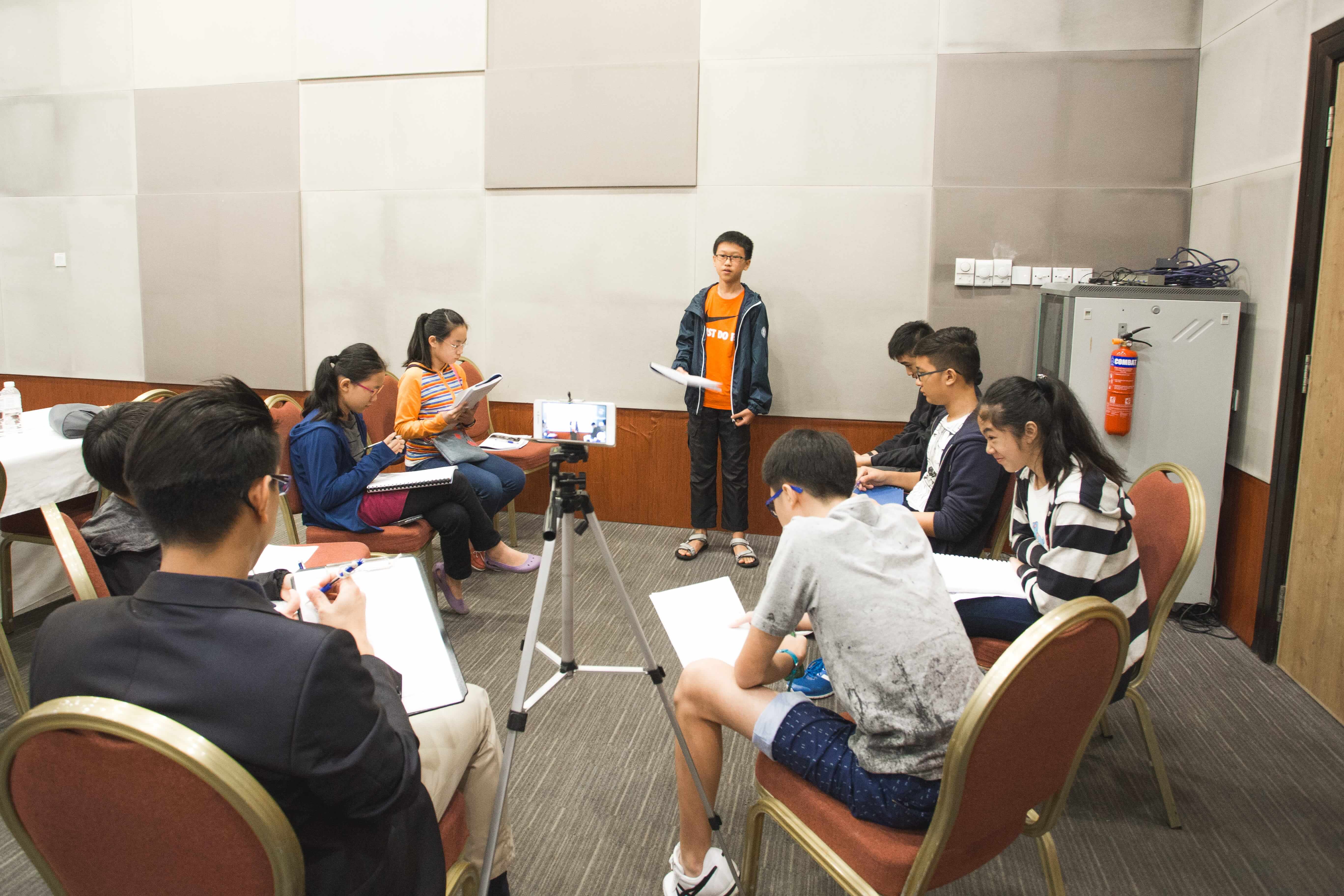
Does my child need Public Speaking classes if he or she already attends Speech & Drama?
Not necessarily. Observe whether your child can organise independent ideas, answer unfamiliar questions, explain opinions and communicate without memorising every sentence. If those skills are already developing well and your child's present needs are being met, additional training may not be necessary.
Can Speech & Drama and Public Speaking complement each other?
Yes. Skills such as confidence, expression, storytelling, vocal variety and body language can transfer between the two. Public Speaking can additionally develop areas such as idea organisation, impromptu communication, interviews, persuasive speaking and responding to unexpected questions.
How can children improve at speaking without a script?
Start progressively. Ask simple questions and teach the child a basic structure such as stating a point, explaining it and supporting it with an example. As the child becomes more comfortable, gradually introduce unfamiliar topics, follow-up questions and more complex speaking situations. Regular practice and specific feedback help make spontaneous communication increasingly familiar.
About Darren Tay
Darren Tay is the Founder and Master Trainer of Public Speaking Academy and the 2016 World Champion of Public Speaking. He has coached children and adults in public speaking, presentation, interview and communication skills, and is the author of Express to Impress and Mastering Interview Questions.
His approach to children's communication training focuses not simply on producing confident performers, but on helping young speakers organise their thoughts, communicate ideas clearly and progressively become more capable of responding to different audiences and situations.