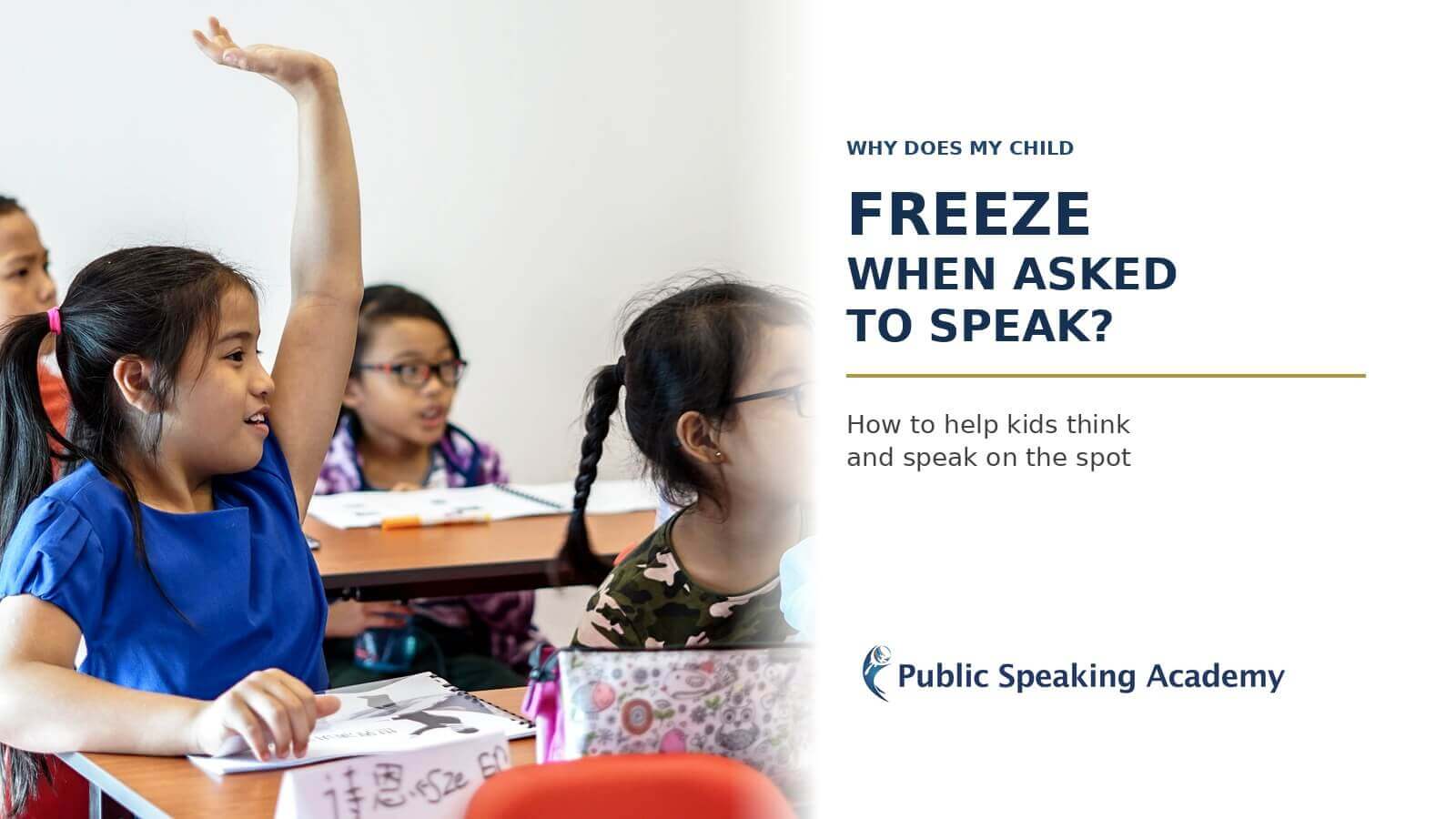
Your child knows the answer.
You have heard them talk about the same subject at home. They may even have explained it perfectly well to you five minutes earlier.
Then a teacher asks them a question in class.
Silence.
Or perhaps they are asked an unexpected question during an interview, oral examination or presentation. They look down, hesitate and eventually say:
“I don't know.”
It is tempting to conclude that the child is shy, lacks confidence or simply does not know what to say.
But after years of training children in public speaking, Darren Tay, 2016 World Champion of Public Speaking and Founder of Public Speaking Academy, has observed that the same outward behaviour — freezing — can have very different underlying causes.
“Going blank does not necessarily mean that the child lacks knowledge or confidence.”
A child might be nervous because everyone is watching. Another might have several ideas but be unable to organise them quickly. Another may be searching so hard for the perfect answer that every ordinary answer gets rejected before it reaches their mouth.
And sometimes, the child simply needs a few more seconds to think.
That distinction matters because telling every child to “just be more confident” does not address the actual problem.
Why Does My Child's Mind Go Blank When Asked a Question?
When a child suddenly freezes, parents and teachers see the outcome.
They do not necessarily see what happened immediately before it.
Based on Darren's observations from training children, there are at least five useful possibilities to consider.
1. Pressure: “Everyone is looking at me.”
A child may know exactly what they want to say in a comfortable one-to-one conversation but struggle when the same question is asked in front of a class.
The additional attention changes the situation.
Instead of thinking only about the answer, the child may also be thinking:
What if I get this wrong?
What will my classmates think?
Why is everyone looking at me?
This is particularly important when helping a shy child become more confident in public speaking.
However, nervousness is only one possible explanation.
2. Perfectionism: “My answer isn't good enough.”
This is easy to mistake for a lack of ideas.
A child thinks of an answer.
Then rejects it.
Another idea appears.
Too simple.
Rejected again.
A third thought comes along.
That's not impressive enough either.
Eventually, so much internal editing has happened that nothing gets said.
Darren encountered one student who initially appeared to lack confidence because he gave very short answers to impromptu questions.
Yet the student could converse comfortably and was not particularly afraid of speaking in front of Darren.
The problem became clearer during training: when asked to give a more formal response, the student became preoccupied with finding the “right” answer. He mentally rejected ideas he considered too simple or insufficiently impressive.
Instead of trying to manufacture a brilliant opening thought, Darren worked with him on accepting a simple first idea and then developing it with reasons and examples.
As the student became less inclined to filter every idea before speaking, Darren observed that his answers became noticeably longer and more natural.
3. Idea Generation: “I genuinely don't know what to say.”
Sometimes the most straightforward explanation is the correct one.
The child may genuinely need help generating ideas.
This is where simple thinking tools can be useful. For example, the familiar questions Who? What? When? Where? Why? and How? can help a child explore a topic from different directions.
The purpose is not to memorise six questions and mechanically recite them.
It is to give the mind somewhere to look when the first response is:
“I don't know.”
4. Organisation: “I have too many thoughts and don't know where to start.”
Interestingly, some children freeze not because their mind is empty, but because it is too full.
Several thoughts arrive at once.
Which one comes first?
How should they connect?
Where does the answer end?
Simple speaking structures can reduce this load.
At Public Speaking Academy, children may encounter frameworks such as PEEL (Point, Explanation, Example, Link) or Past–Present–Future, depending on the speaking situation.
A structure does not create the child's opinion for them.
It gives that opinion somewhere to go.
5. Retrieval and Expression: “I know it — give me a moment.”
Children do not necessarily retrieve information at identical speeds.
A child may understand a topic but need additional processing time to access an example, find the words and formulate a coherent sentence.
If we interpret every three-second pause as failure and immediately jump in with the answer, we may never discover what the child could have produced with another few seconds.
That brings us to one of the most important lessons for parents and trainers.
Don't Diagnose the Freeze From the Freeze
Two children can produce exactly the same behaviour:
Question → Silence
while experiencing completely different difficulties.
So rather than immediately concluding:
“My child lacks confidence,”
look at what happens when one obstacle is removed.
Darren explains:
“We need to observe what happens after the initial freeze: Can the child answer when given more time? Can they explain the same idea comfortably one-to-one? Can they respond when the question is broken down into something simpler?”
Those observations tell us far more than the silence itself.
This is also why parents should look beyond broad promises when choosing a public speaking class for their child.
A trainer should be able to observe what is preventing the child from communicating, rather than treating every speaking difficulty as the same confidence problem.
A Simple Way to Find Out Why Your Child Is Stuck
Darren uses a particularly practical approach during training:
Remove some of the pressure without changing the question.
Suppose a student freezes.
Instead of immediately supplying the answer, he may first give the child additional thinking time.
Then:
“What is the first thing that comes to your mind?”
If necessary, Darren might ask the student to give him two or three keywords rather than complete sentences.
That creates a useful diagnostic clue.
If a child can readily produce three relevant keywords but cannot convert them into a spoken response, idea generation probably isn't the main problem.
The difficulty may lie more in organising or expressing those ideas.
Likewise, consider what happens when the audience changes.
A child who cannot answer in front of ten peers but comfortably explains the same idea to the trainer afterwards has shown us something important.
The knowledge was there.
The context changed their ability to access or express it.
Darren describes the underlying principle this way:
“Good diagnosis comes from gradually removing different obstacles and observing at which point the child is able to respond.”
In practice, we can think of it as:
Give More Time → Ask for the First Thought → Reduce It to Keywords → Simplify the Question → Reduce Audience Pressure → Observe What Changes
This is not about diagnosing a medical or developmental condition. It is simply a practical coaching method for understanding where a child's speaking difficulty may be occurring.
What Should a Trainer Do When a Child Freezes?
There is a natural temptation to rescue them.
The child looks uncomfortable.
The silence feels awkward.
The adult knows the answer.
So the adult supplies it.
Problem solved — except perhaps it isn't.
Darren generally avoids immediately answering on the student's behalf.
“Doing so can unintentionally teach the child that whenever there is an uncomfortable silence, an adult will rescue them.”
Instead, the amount of support can increase gradually.
First, wait.
Give the child some processing time.
Still stuck? Offer one keyword.
Not the whole answer — just enough to restart the thinking process.
Still difficult? Simplify the question.
A broad question can become a smaller one.
Get one idea.
Forget the polished speech for the moment.
Develop it.
Ask:
“Why?”
Then:
“Can you give me an example?”
A one-sentence response can gradually become a point, a reason and an example.
If appropriate, the student can then restart the answer after gathering their thoughts.
Darren explains:
“The objective is not to eliminate every moment of silence; it is to give the child enough support to succeed while still allowing them to experience the process of finding their own answer.”
That final part is crucial.
The trainer provides the scaffolding. The answer still belongs to the child.
Don't Rescue the Silence Too Quickly
Silence can feel uncomfortable to adults too.
Imagine this happening at a family gathering:
Relative: “So, what do you want to be when you grow up?”
Child: “Erm…”
One second.
Two seconds.
Parent:
“He wants to be an engineer! Tell Auntie about the robotics thing you did!” 😂
Perfectly understandable.
But if this happens repeatedly, the child loses an opportunity to experience:
Pause → Think → Retrieve → Formulate → Respond
Darren recommends allowing some silence when children are thinking.
Those few seconds can teach the child to tolerate the temporary discomfort of not having an immediate answer and discover:
I can find my own way to a response.
Pausing itself is not necessarily a sign of poor speaking. Even experienced speakers use deliberate pauses to collect their thoughts, transition between ideas and regain their train of thought.
Darren has previously written about ways speakers can respond when their mind suddenly goes blank during a presentation.
The goal for a child therefore isn't:
Never pause.
It is:
Learn what to do during the pause.
Teach Children to Develop a Simple Idea Instead of Waiting for a Brilliant One
 One reason children struggle with impromptu speaking is the belief that their first idea must already be impressive.
It doesn't.
Suppose we ask:
“Would you rather have a longer school day but no homework, or a shorter school day with homework?”
A child chooses:
“Longer school day.”
That's enough to begin.
Why?
“Because I can finish all my work in school.”
Example?
“If teachers give us time to complete our assignments before going home, I can ask them when I don't understand something.”
What would that change?
“Then when I get home, I can rest or spend time on other activities.”
The child did not need an extraordinary idea.
They needed to develop an ordinary one.
This is where structures such as PEEL can become useful:
Point → Explanation → Example → Link
For other topics, Past–Present–Future may provide an easier mental roadmap.
The framework is not supposed to replace thinking.
It reduces the number of things the child has to figure out simultaneously.
Thinking on the Spot Does Not Mean Answering Instantly
 There is another misconception worth addressing.
Being good at impromptu speaking does not mean becoming the fastest person in the room.
A thoughtful two- or three-second pause can be considerably more useful than immediately filling the space with:
“Erm… like… basically… I don't know… maybe…”
In Darren's broader impromptu-speaking methodology, children can learn to pause, clarify what is being asked, generate or retrieve relevant ideas, organise those ideas and then respond.
The aim is not simply speed.
It is increasingly efficient thinking under reasonable pressure.
This is also why practising spontaneous communication matters alongside prepared speeches. As Darren explained when discussing Public Speaking versus Speech & Drama for children:
“Speaking without a script is itself a skill that can be learnt rather than something you either naturally can or cannot do.”
Where Will Children Actually Need This Skill?
Almost everywhere.
A teacher asks:
“Why do you disagree?”
An oral examiner follows up:
“What makes you say that?”
An interviewer asks:
“Tell me about a time you failed.”
A classmate challenges:
“But wouldn't that be unfair?”
A presentation ends with:
“Any questions?”
A child cannot prepare a memorised script for every possible interaction.
That is why public speaking is not merely the ability to deliver a prepared speech confidently.
Children also need opportunities to listen, understand, think, organise and respond when the next question is unknown.
That ability becomes useful in classroom discussions, interviews, oral communication, leadership roles, presentations, competitions and ordinary conversations.
How Can Parents Practise This at Home Without Creating “Tuition at Dinner”? 😂
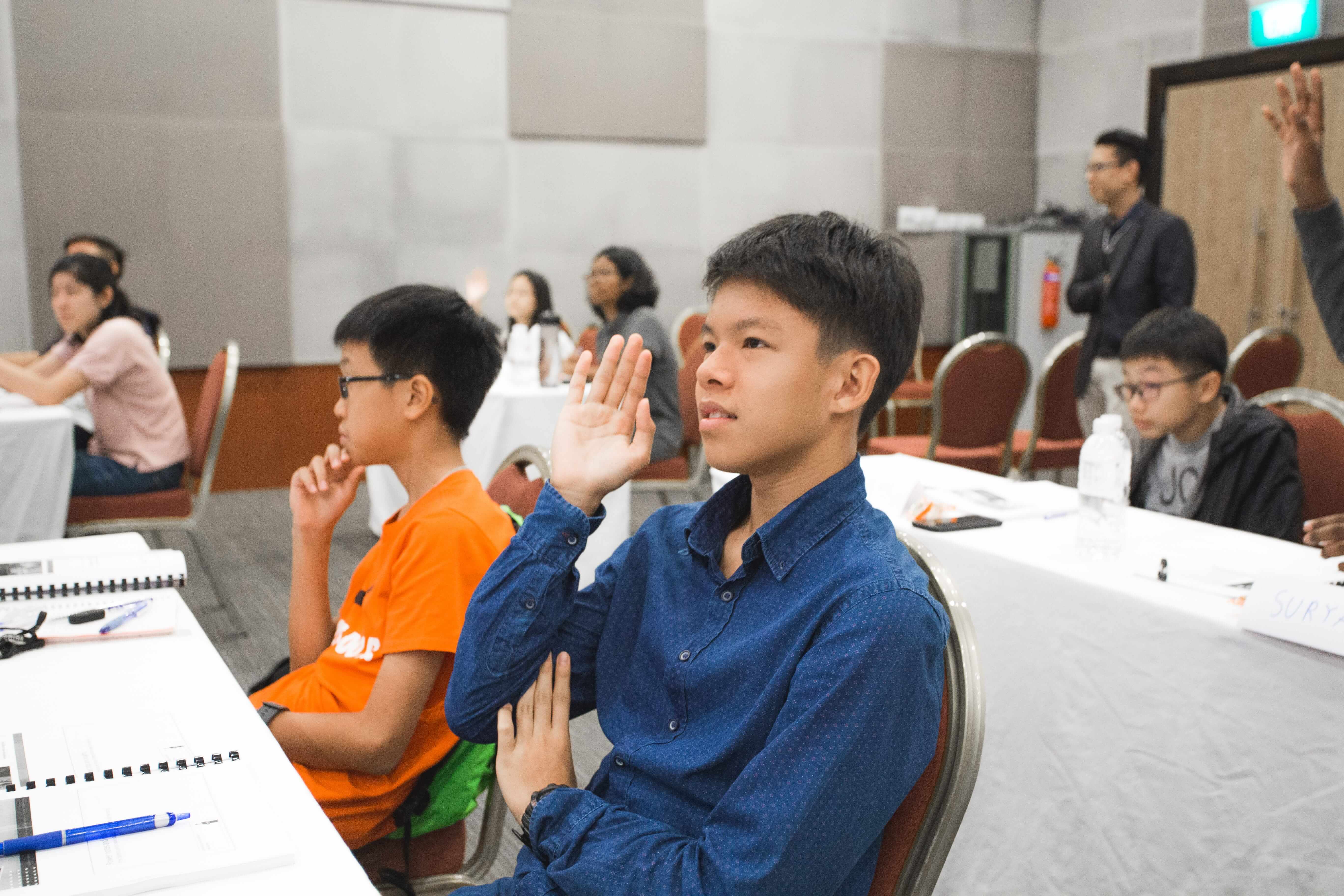 You don't need a lectern.
You don't need PowerPoint slides.
And please don't announce:
“It is now 7:30pm. Welcome to today's compulsory impromptu-speaking practice.”
Ordinary conversation is enough.
Instead of relying only on factual questions such as:
“What did you learn today?”
occasionally ask for an opinion.
Darren suggests questions such as:
“What was the most interesting thing that happened today and why?”
Or:
“If you could change one school rule, what would you change?”
And perhaps the most Singaporean public-speaking exercise possible:
“Which is better, chicken rice or pizza, and why?” 😂
The topic can be completely unserious.
What matters is the thinking process:
Choose → Explain → Give a Reason → Respond to a Follow-Up
Once the child answers, resist the urge to evaluate immediately.
Instead, continue the conversation:
“Why?”
“Can you give me an example?”
“What if your friend disagrees?”
“Would your answer change if…?”
Car rides, meals and walks can also become opportunities for hypothetical scenarios, storytelling games and playful mini-debates.
The activity should feel more like conversation than examination.
What Should Parents Avoid When Their Child Freezes?
Don't Answer for Them Immediately
Two or three seconds can feel surprisingly long when everyone is waiting.
Give the child an opportunity to work through it.
Don't Repeatedly Say, “Don't Be Nervous.”
Darren cautions that continually saying this can inadvertently reinforce the idea that there is something the child should be nervous about.
Instead, focus attention on the next manageable task:
“Take a moment. What's your first idea?”
Don't Demand the Perfect Answer Immediately
A simple idea that belongs to the child is more useful for training than an impressive answer supplied by an adult.
Don't Correct Every Mistake While the Idea Is Still Forming
This is one of Darren's most important distinctions:
“There is a time for correction and a time for expression.”
If a child is trying to formulate an unfamiliar answer while simultaneously being corrected for grammar, vocabulary, posture, volume and sentence construction, speaking can become increasingly self-conscious.
Let the thought emerge.
Then choose one or two focused areas to improve afterwards.
Don't Replace Adaptability With Memorisation
Prepared answers have their place.
But children also need practice dealing with the question they didn't expect.
A memorised response can help when the predicted question appears.
Adaptability helps when it doesn't.
A Real Student's Perspective: From Fear of Judgement to Speaking Up
The difference repeated speaking experiences can make is also reflected in the experience of Joyston Boon, a graduate of Public Speaking Academy's Speech Excellence Program from 2024–2025.
Joyston described being very afraid of public speaking before training, particularly worrying about how other people would judge him. In front of crowds or cameras, he recalled stuttering and fidgeting with his clothes or hair.
His progress was gradual.
He described having designated opportunities to speak during training, patient guidance from trainers and encouragement from classmates.
One realisation particularly changed his relationship with speaking:
“People actually enjoy the stories more than judging the stories.”
Over time, Joyston said he began participating more in school, including speaking in front of his class and emceeing events.
He eventually entered the 2025 National Public Speaking Competition, where he achieved 3rd Place in the Secondary category.
Joyston's result should not be treated as a promise that every child's journey will follow the same path. What his experience illustrates particularly well is something simpler:
Confidence and spontaneous communication can develop progressively through opportunities to speak, struggle, receive support and try again.
Should I Enrol My Child in a Public Speaking Class?
Not necessarily just because they occasionally pause.
Everyone needs thinking time.
But if your child repeatedly struggles to express ideas in situations such as classroom discussions, presentations, oral communication or interviews, it may be useful to identify where the difficulty actually lies.
Ask yourself:
Can my child explain the idea comfortably one-to-one?
Can they give me keywords even when they cannot produce sentences?
Do they freeze mainly when other people are watching?
Are they rejecting simple answers because they want the perfect one?
Can they develop an opinion when I ask “Why?” or “Can you give me an example?”
Does additional thinking time substantially change the answer?
If training would be useful, look for programmes that provide genuine opportunities to speak rather than only teaching children about speaking.
Public Speaking Academy's weekly Speech Excellence Program for children and teenagers covers different communication genres across the year and gives students opportunities to practise and receive feedback.
For families seeking a shorter intensive format, the S'Peak Performance Kids school-holiday programme includes impromptu speaking alongside presentations, interviews, oral communication and other speaking situations.
The programme format matters less than whether the training addresses the child's actual communication gap and gives them sufficient opportunity to practise.
The Goal Is Not to Make Sure Your Child Never Freezes Again
Everyone gets stuck occasionally.
Adults do too.
The more useful objective is to help children discover that getting stuck does not mean the conversation is over.
They can pause.
They can begin with one ordinary idea.
They can organise it.
They can explain why.
They can find an example.
And they can continue.
As Darren puts it:
“The aim is to create enough psychological space for the child to think, attempt, occasionally struggle, and eventually discover that they can find their own way to an answer.”
Perhaps that is the most valuable change of all.
Instead of experiencing silence and thinking:
“I can't answer this.”
the child gradually learns to think:
“Give me a moment. I'll find my answer.”
Frequently Asked Questions
Why Does My Child Know the Answer at Home but Freeze When Asked in Class?
The difficulty may not be knowledge. Some children experience additional pressure when others are watching, need more processing time, struggle to organise several ideas quickly, or become preoccupied with producing the “correct” answer.
Try giving the child additional thinking time or asking for two or three keywords first. What changes can provide clues about the underlying difficulty.
How Can I Help My Child Think Faster When Speaking?
Focus less on answering faster and more on thinking more efficiently.
Give your child practice forming opinions, explaining reasons, giving examples and responding to follow-up questions. Simple frameworks such as PEEL or Past–Present–Future can also help organise thoughts when appropriate.
Should I Help When My Child Goes Silent?
Give them a little thinking time before stepping in.
If they remain stuck, offer progressively smaller forms of support: ask for their first thought, provide a keyword, simplify the question or ask them for one idea.
The objective is to support the thinking process without supplying the entire answer.
Can Public Speaking Classes Help Children With Impromptu Speaking?
They can, provided children actually receive opportunities to practise spontaneous speaking and receive useful feedback.
Look for training that includes unfamiliar questions, idea generation, simple speaking structures, repeated practice and progressive support rather than relying primarily on memorised scripts.
Is Freezing When Speaking Always Caused by Shyness?
No.
In Darren Tay's coaching experience, children may freeze because of nervousness, perfection pressure, difficulty generating or organising ideas, or simply needing additional processing time.
The same outward silence can therefore have different causes.
About Darren Tay
Darren Tay is the Founder and Master Trainer of Public Speaking Academy, and the 2016 World Champion of Public Speaking.
He has trained children, teenagers and adults in public speaking, presentation, impromptu communication and interview skills.
His approach emphasises not simply telling students what effective communication looks like, but giving them opportunities to practise, receive specific feedback and progressively apply those skills in increasingly challenging speaking situations.