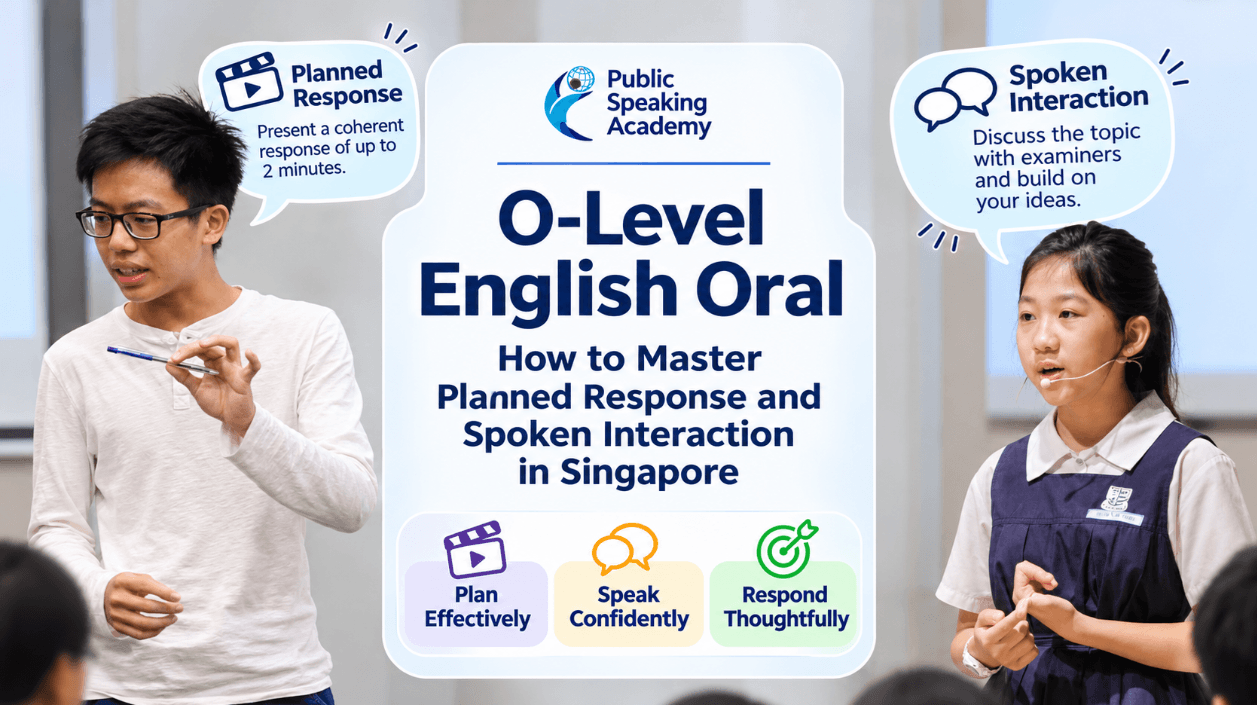
A practical guide for secondary school students preparing for O-Level and SEC G3 English Oral, featuring coaching insights from Darren Tay, 2016 World Champion of Public Speaking.
Imagine watching a short video during your English Oral examination. You understand what is happening, and you recognise the topic. Yet, when you begin speaking, you find yourself describing the video instead of answering the question.
Or perhaps you have several good ideas, but you struggle to organise them into a coherent two-minute response.
Then comes Spoken Interaction. Just when you think you have explained your opinion convincingly, the examiner asks a follow-up question that challenges your argument.
What should you do?
According to Darren Tay, Founder and Master Trainer of Public Speaking Academy and 2016 World Champion of Public Speaking, the solution is not to memorise more model answers.
It is to develop the ability to think clearly, organise ideas and respond naturally.
In this guide, we explore common English Oral mistakes, a practical ten-minute preparation strategy, examples of stronger Planned Responses, and techniques for handling challenging Spoken Interaction questions.
Understanding the O-Level and SEC G3 English Oral Examination
The English Oral examination assesses more than a student's ability to speak fluent English. It also requires students to organise their thoughts, express opinions and engage in meaningful discussion.
Under the 2026 GCE O-Level English Language syllabus (1184), Paper 4: Oral Communication carries 30 marks, representing 20% of the overall English Language assessment.
The examination comprises two components:

Candidates are given ten minutes of preparation time. The total oral examination duration is approximately 20 minutes, including preparation.
What changes from 2027?
From 2027, Singapore's GCE O-Level and N-Level examinations will be replaced by the Singapore-Cambridge Secondary Education Certificate (SEC).
For students taking English at G3 level, the published 2027 SEC English Language syllabus (K300) retains the two oral components, with 15 marks each and an overall 20% weighting.
The strategies in this article are therefore relevant to students preparing for the 2026 O-Level English Oral and the 2027 SEC G3 English Oral.
Official references: SEAB's 2026 O-Level syllabuses and 2027 SEC G3 syllabuses. Students should always refer to the syllabus applicable to their examination year.
Why Students Struggle With O-Level Planned Response

Planned Response may appear straightforward. Students watch a video, consider a question and deliver a short presentation.
However, Darren identifies four recurring difficulties among secondary school students.
1. Describing the Video Instead of Answering the Question
Suppose a video shows students participating in a community clean-up, and the accompanying question asks:
“Do you think young people should be encouraged to volunteer?”
A student might spend most of the response describing the students picking up litter, collecting rubbish and cleaning the park.
These observations may be accurate, but they do not adequately address the question.
The examiner is interested in the student's ability to develop an opinion about volunteering.
Darren's coaching advice: Use the video as a starting point, not as the entire response.
A relevant video detail should support an argument rather than replace it.
2. Having Good Ideas but No Clear Structure
Some students generate several interesting points but present them in a confusing order.
They may begin discussing personal responsibility, switch to school activities, mention environmental issues and then return to their original argument.
Without a logical sequence, even useful ideas can lose their impact.
3. Running Out of Content Too Quickly
Other students state their opinions but provide little explanation.
For example:
“I think outdoor activities are important because they are healthy and fun. Students can exercise and make friends. That is why schools should encourage outdoor activities.”
Although relevant, the answer does not fully explain how outdoor activities benefit students or provide a specific supporting example.
Darren encourages students to develop their arguments instead of simply adding more points.
4. Memorising Entire Responses
Students sometimes attempt to write and memorise a complete response during preparation.
This can create two problems.
First, writing full sentences consumes valuable preparation time.
Second, memorisation can make delivery unnatural. If a student forgets one sentence, the rest of the response may become difficult to retrieve.
Darren's central reminder is simple:
Planned Response is not a memory test.
Two thoughtfully developed arguments are often more effective than five superficial points.
How to Use the 10-Minute Preparation Time Effectively
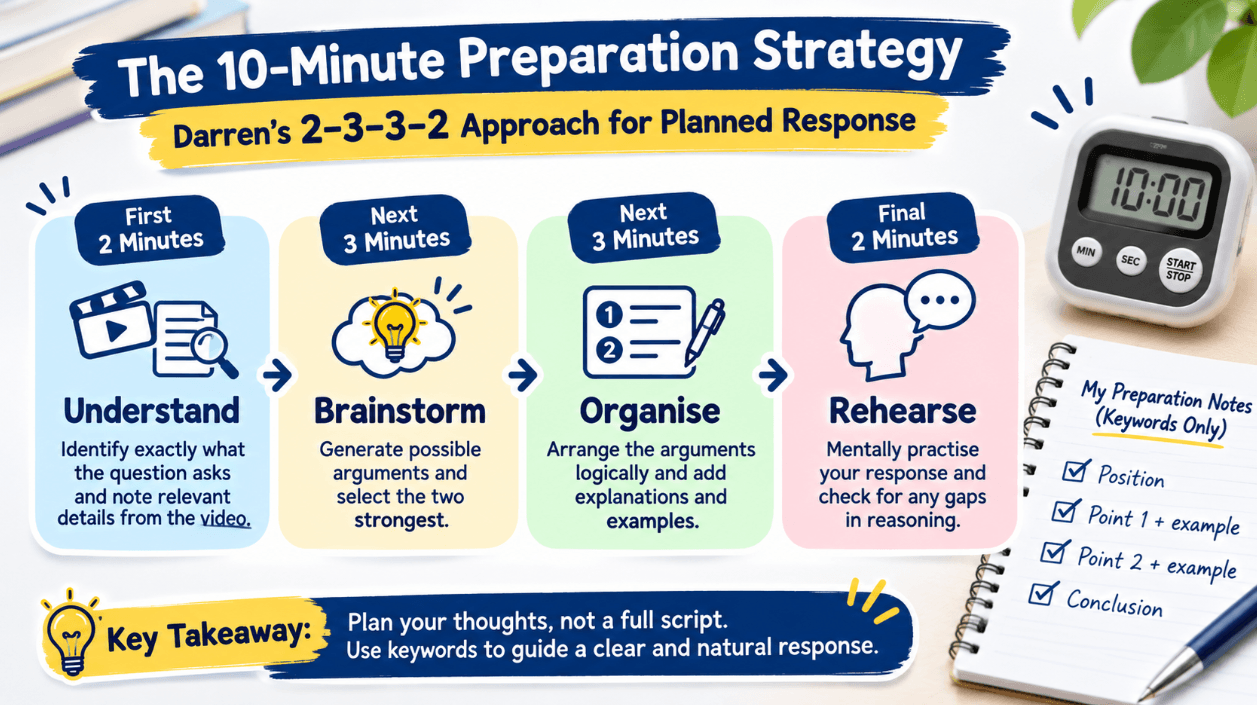
Darren Tay's 2–3–3–2 preparation strategy helps students organise their ideas within ten minutes without memorising a complete script.
One of the most practical techniques Darren teaches is a structured approach to the ten-minute preparation period.
Rather than rushing to write a speech, students can divide their time into four stages.
Darren's 2–3–3–2 Preparation Strategy
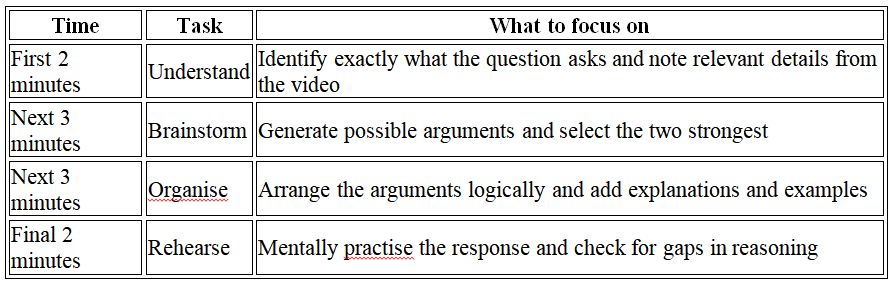 These timings are coaching guidelines, not official examination requirements.
Step 1: Understand the Question Before Generating Ideas
Read the prompt carefully.
Pay attention to words such as should, important, beneficial, necessary and encouraged.
For example, consider the difference between:
“What are the benefits of outdoor activities?”
and
“Should schools make outdoor activities compulsory?”
The first asks students to discuss benefits. The second requires them to consider whether participation should be mandatory.
A response that ignores this distinction may contain relevant information without fully answering the question.
Step 2: Choose Two Strong Arguments
Brainstorm several ideas, then select the two that are easiest to explain convincingly.
For a question about encouraging outdoor activities, a student might choose:
Physical well-being: Outdoor activities encourage movement and healthier habits.
Social development: They allow students to interact and collaborate beyond the classroom.
Two distinct arguments provide a useful foundation for a balanced, organised response.
Step 3: Write Keywords, Not a Full Script
Instead of writing paragraphs, create brief reminders:
Position: Agree — encourage outdoor activities
Point 1: Physical health → movement → school hiking activity
Point 2: Social interaction → teamwork → classmates outside lessons
Conclusion: Benefits beyond academic learning
These notes help students remember the direction of their response without becoming dependent on exact wording.
Step 4: Rehearse the Flow, Not Every Sentence
Use the remaining preparation time to mentally review:
Does my introduction answer the question?
Are my two points different?
Have I explained each point?
Can I give a relevant example?
Does my conclusion reinforce my position?
The objective is to feel prepared to communicate, not pressured to recite.
How to Structure a Strong Two-Minute Planned Response
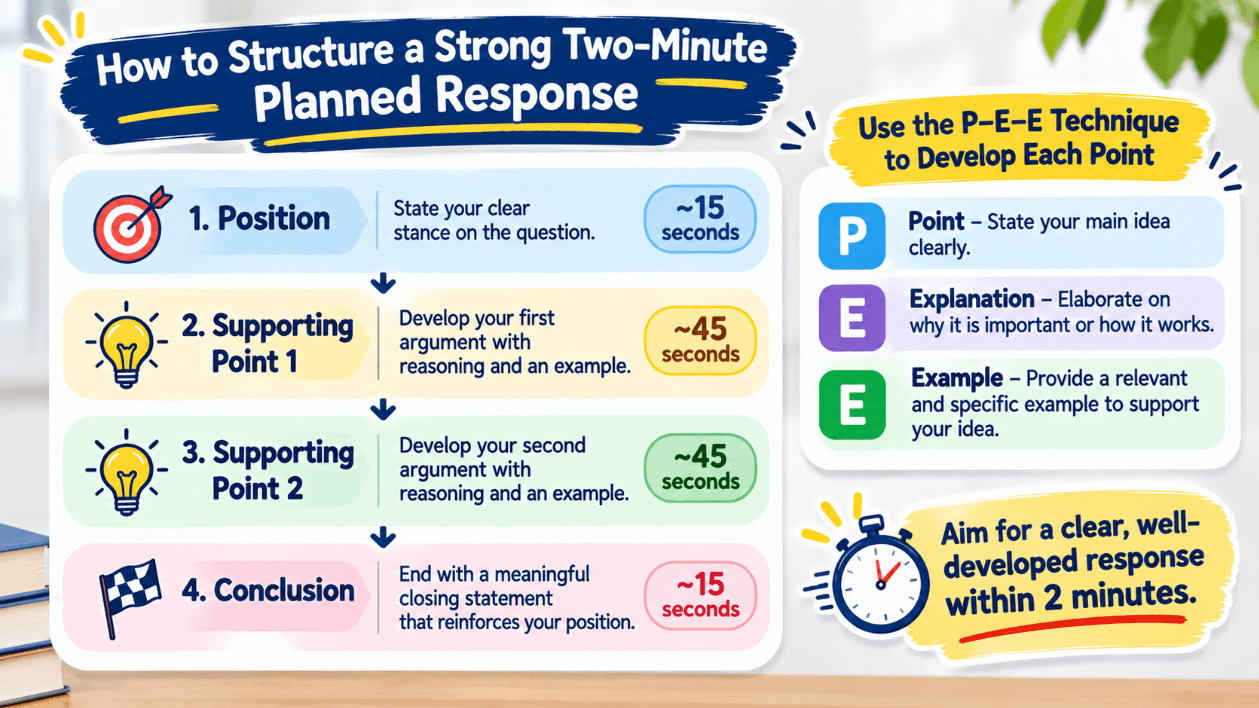
A practical two-minute Planned Response structure: state your position, develop two arguments using Point–Explanation–Example, and conclude meaningfully.
Darren recommends a straightforward structure:
Position → Supporting Point 1 → Supporting Point 2 → Conclusion
Each supporting argument can be developed using:
Point → Explanation → Example
For example, if the question asks whether schools should encourage outdoor activities:
Position: I believe schools should encourage students to participate in outdoor activities.
Point 1 — Physical well-being: Outdoor activities help students remain physically active.
Explanation: Many students spend long hours sitting in classrooms or using digital devices. Outdoor activities provide opportunities to move, exercise and develop healthier routines.
Example: A school hiking activity could encourage students who rarely exercise to explore an accessible trail with their classmates.
Point 2 — Social development: Outdoor activities can strengthen relationships among students.
Explanation: When students collaborate outside the classroom, they may discover different strengths in their classmates and learn to communicate more effectively.
Example: During an outdoor team challenge, students might need to plan a route, assign responsibilities and support one another.
Conclusion: Schools should therefore encourage outdoor activities because they contribute to students' physical and social development.
How Long Should Each Part Take?
Darren suggests the following approximate allocation for a two-minute response:
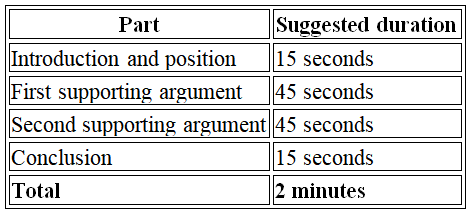
These timings are flexible. Students should not rush or interrupt a meaningful explanation merely to meet an exact number of seconds.
The more important goal is to communicate clearly and stay within the permitted duration.
Planned Response Example: Before and After Coaching
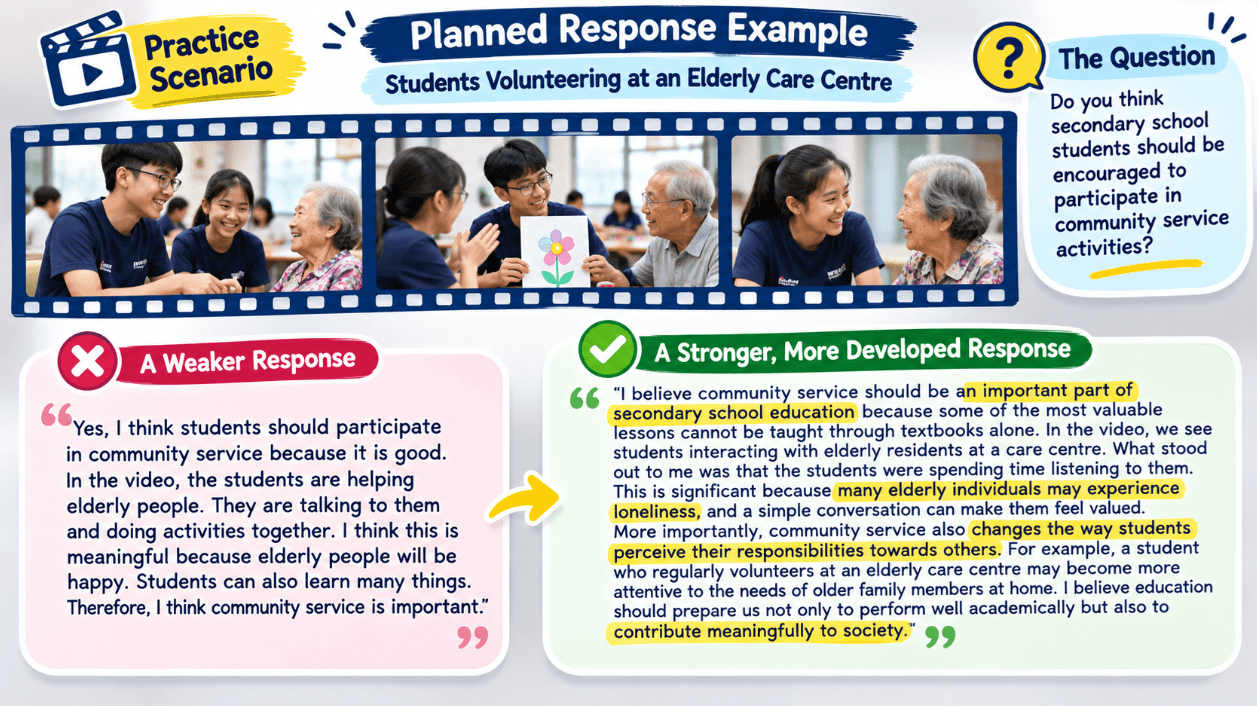
An original practice scenario illustrating how students can strengthen their Planned Response by moving beyond video description to develop thoughtful arguments and relevant examples.
Let's examine a hypothetical video scenario provided by Darren.
Practice video: Secondary school students visit an elderly care centre. They organise activities, speak with residents and help with simple tasks.
Practice question:
“Do you think secondary school students should be encouraged to participate in community service activities?”
This is an original PSA practice scenario, not an official examination question.
Example of a Weaker Response
“Yes, I think students should participate in community service because it is good. In the video, the students are helping elderly people. They are talking to them and doing activities together. I think this is meaningful because elderly people will be happy. Students can also learn many things. Therefore, I think community service is important.”
Why This Response Needs Improvement
The student expresses an opinion, but the response has several limitations.
It relies heavily on describing what happens in the video.
The reasons are vague: “it is good” and “students can learn many things” do not explain what makes community service valuable.
The conclusion also repeats the original position without adding a meaningful insight.
Example of an Improved Response
“I believe community service should be an important part of secondary school education because some of the most valuable lessons cannot be taught through textbooks alone.
In the video, we see students interacting with elderly residents at a care centre. What stood out to me was not simply that the students were helping the residents, but that they were spending time listening to them.
This is significant because many elderly individuals may experience loneliness, and a simple conversation can make them feel valued.
More importantly, community service also changes the way students perceive their responsibilities towards others.
For example, a student who regularly volunteers at an elderly care centre may become more attentive to the needs of older family members at home.
I believe education should prepare us not only to perform well academically but also to contribute meaningfully to society.”
What Makes the Improved Response Stronger?
The improved response demonstrates several important skills.
It establishes a clear position. The student immediately explains why community service matters.
It uses the video selectively. Rather than narrating every activity, the student identifies a meaningful detail: listening to elderly residents.
It develops the reasoning. The response connects companionship with the emotional well-being of elderly individuals.
It extends the argument. The student considers how volunteering can influence behaviour beyond the activity itself.
It concludes with a broader insight. The final statement connects community service with the purpose of education.
This is an example of a more developed response, not a script that students should memorise. Students should practise applying the same reasoning techniques to unfamiliar topics.
Planned Response vs Spoken Interaction: What's the Difference?
Although both components assess oral communication, they require different approaches.
Darren explains that Planned Response gives students an opportunity to organise their thoughts before speaking, while Spoken Interaction requires them to respond in real time.
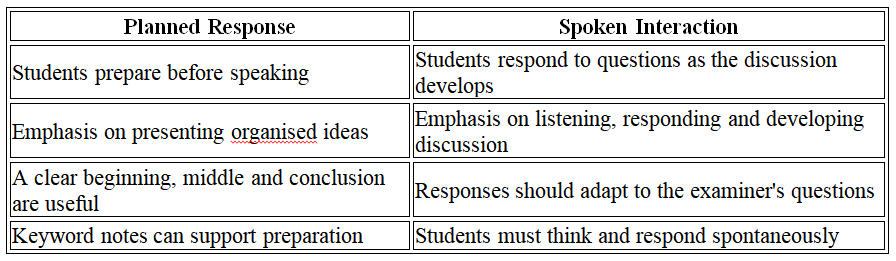
A common mistake in Spoken Interaction is treating every question as another miniature presentation.
Students may deliver lengthy answers without fully considering what the examiner has asked.
However, meaningful interaction is not simply about speaking for as long as possible.
It involves listening carefully, answering directly and being willing to explore different perspectives.
How to Give Better Answers During Spoken Interaction

Through guided discussions and speaking practice, students can strengthen their ability to listen, express opinions and respond thoughtfully.
1. Listen for What the Examiner Is Actually Asking
Consider these two questions:
“Have you ever helped someone in your community?”
“Do you think Singaporeans are sufficiently involved in community service?”
The first invites a personal experience.
The second asks for a broader opinion about society.
A student who gives the same memorised answer to both questions may fail to address their different purposes.
Darren teaches students to distinguish between questions that require personal experiences and those that invite wider discussion.
2. Answer Directly Before Expanding
Students do not need to begin every response with a long introduction.
A direct answer provides a foundation for elaboration.
For example:
Question: “Do you think schools should reduce homework?”
Initial response: “I think schools could reduce some homework, particularly repetitive assignments, because students also need time to rest and pursue other interests.”
The student can then explain the reasoning, provide an example or respond to further questions.
3. Practise Short Answers That Can Be Developed
One exercise Darren uses is to ask students to respond to a question in approximately 30 seconds.
He then asks follow-up questions that require them to expand their ideas.
This helps students learn that a thoughtful conversation can develop gradually.
They do not need to deliver every possible argument immediately.
How to Handle Difficult Follow-Up Questions
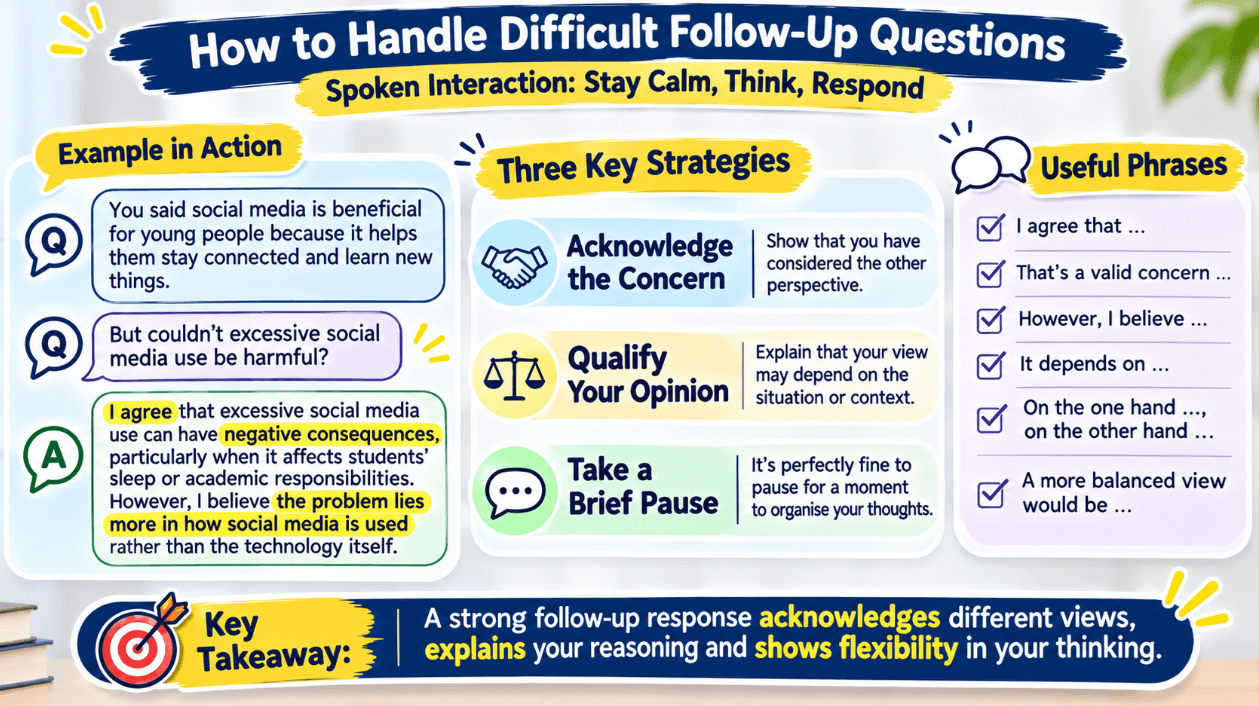
Darren Tay's strategies for Spoken Interaction: acknowledge different perspectives, explain your reasoning and remain flexible when responding to challenging questions.
Imagine a student says:
“Social media is beneficial for young people because it helps them stay connected and learn new things.”
The examiner then asks:
“But couldn't excessive social media use be harmful?”
A nervous student might immediately defend the original opinion, even when the examiner raises a reasonable concern.
Darren recommends a more thoughtful approach.
Acknowledge the Concern Before Explaining Your Position
A possible response is:
“I agree that excessive social media use can have negative consequences, particularly when it affects students' sleep or academic responsibilities. However, I believe the problem lies more in how social media is used rather than the technology itself.”
This answer does not simply reject the examiner's concern.
Instead, it acknowledges a valid point while explaining a more nuanced position.
Learn to Qualify Your Arguments
A qualified argument recognises that an opinion may depend on circumstances.
For example:
Initial opinion: “Competition is beneficial because it motivates students.”
Follow-up question: “Can competition create unnecessary stress?”
More thoughtful response: “Yes, excessive competition can create stress, especially when students feel that their worth depends entirely on their results. However, healthy competition can still be beneficial when the emphasis is on improvement rather than defeating others.”
The student demonstrates flexibility without completely abandoning the original argument.
Take a Brief Pause When Necessary
Students sometimes assume that hesitation is always a weakness.
However, a short, deliberate pause can provide time to process a challenging question and organise a relevant response.
The goal is not to answer every question instantly.
It is to answer thoughtfully.
Three Practical Exercises to Improve Spoken Interaction
Darren uses several exercises to help students become more adaptable during discussions.
Exercise 1: Argue Both Sides
Choose a debatable topic:
“Should schools restrict students' mobile phone usage?”
Ask the student to explain why restrictions may be beneficial.
Then ask the student to defend the opposite perspective.
This exercise encourages students to consider different viewpoints and avoid becoming overly attached to a single argument.
Exercise 2: Respond to Unexpected Challenges
Begin with a straightforward opinion:
“Schools should reduce homework.”
Then introduce a challenge:
“Wouldn't reducing homework affect students' academic performance?”
Encourage the student to acknowledge the concern and explain their reasoning.
This develops the ability to respond rather than repeat.
Exercise 3: Introduce a Hypothetical Exception
Ask:
“Should all students be required to participate in community service?”
After the student answers, introduce a new condition:
“What about students who have demanding family responsibilities?”
The student must consider whether the original position still applies in every situation.
Darren uses such scenarios to develop intellectual flexibility and more persuasive reasoning.
When Students Have Ideas but Struggle to Express Them
Not every weak oral response comes from a lack of knowledge.
Sometimes, students have useful ideas but become so concerned about producing the perfect answer that they struggle to express them.
Darren shares an illustrative coaching scenario involving a secondary school student discussing environmental conservation.
The Initial Difficulty
The student watches a practice video about environmental conservation and is asked:
“Do individuals have a responsibility to protect the environment?”
The student agrees but struggles to develop the answer beyond general statements about keeping Singapore clean and reducing waste.
When asked to elaborate, the student becomes hesitant.
The Coaching Approach
Instead of providing a model response to memorise, Darren begins with conversational questions.
He might ask whether the student has noticed excessive food packaging at takeaway stalls or considered how businesses could reduce unnecessary waste.
These familiar situations help the student retrieve ideas from everyday observations.
Darren then guides the student to organise those ideas using:
Point → Explanation → Example
Next, he introduces a timed exercise in which the student has only one minute to prepare using keywords.
The purpose is to reduce dependence on extensive notes and encourage greater confidence in developing ideas while speaking.
The Learning Outcome
In this illustrative scenario, the student's responses become more developed over successive practice rounds, and the student learns to recover more effectively when an idea does not come immediately.
The key lesson is that stronger oral communication does not always require sophisticated vocabulary or elaborate phrases.
Sometimes, students already possess useful ideas.
What they need is guidance in retrieving, organising and communicating those ideas.
Editorial note: This is an illustrative coaching scenario based on challenges Darren commonly encounters, not a documented account of an individual student's examination results.
How Parents Can Help Secondary School Students Practise English Oral at Home
Parents do not need to conduct a formal mock examination every day.
Short, meaningful conversations can help students practise expressing opinions, explaining reasoning and responding to different perspectives.
Here are five practical approaches.
1. Discuss Everyday Issues
Ask questions about topics students encounter regularly.
For example:
Should students have more opportunities to learn outside the classroom?
Are mobile phones more helpful or distracting for teenagers?
Should community service be compulsory in secondary schools?
How can young people contribute to environmental conservation?
Encourage students to explain why they hold a particular opinion.
2. Ask One Useful Follow-Up Question
Instead of correcting every sentence, ask:
“Can you give me an example?”
“Why do you think that?”
“Would your opinion change in a different situation?”
These questions help students develop their reasoning naturally.
3. Practise Speaking From Keywords
Give the student a topic and a short preparation period.
Ask them to write only a few keywords before speaking.
This reduces reliance on memorised sentences.
4. Use Timed Practice Without Creating Unnecessary Pressure
Students can practise a two-minute Planned Response and review whether their arguments were sufficiently developed.
However, timing should support organisation rather than encourage students to speak unnaturally quickly.
5. Focus Feedback on One Improvement at a Time
After a practice response, identify one strength and one area for improvement.
For example:
“Your opinion was clear. Next time, try giving a more specific example to support your second point.”
Specific, manageable feedback is generally more useful than a long list of corrections.
For students who become hesitant or freeze when questioned, parents may also find our guide on why children freeze when asked to speak helpful.
Building Stronger Communication Skills Beyond English Oral Examinations
Although Planned Response and Spoken Interaction are examination components, the underlying skills extend beyond school assessments.
The ability to organise an argument is useful when delivering presentations.
The ability to listen and respond thoughtfully matters during interviews.
The ability to acknowledge opposing perspectives is valuable in group discussions and everyday conversations.
At Public Speaking Academy, students develop communication skills through guided speaking practice, structured techniques and feedback.
Our weekly public speaking classes for students aged 7–18 provide opportunities to practise expressing ideas and communicating before others.
Students can also explore our two-day school holiday public speaking programme to build speaking confidence and practical communication skills.
For students preparing for interviews, our Interview Skills programme offers another avenue to strengthen their ability to organise and communicate responses.
These programmes develop transferable communication skills; parents should check the current programme scope when seeking preparation for a specific examination.
Frequently Asked Questions About O-Level English Oral
How many marks is O-Level English Oral worth?
Under the 2026 GCE O-Level English Language syllabus (1184), Oral Communication is worth 30 marks, or 20% of the overall English Language assessment. Planned Response and Spoken Interaction are worth 15 marks each.
The published 2027 SEC G3 English Language syllabus retains the same oral weighting and mark allocation.
How long is the O-Level Planned Response?
Students deliver a response of up to two minutes. They should aim to present a clear position, develop relevant arguments and conclude meaningfully within the permitted time.
How much preparation time do students get?
Students receive ten minutes to prepare their Planned Response. Darren recommends dividing this time into understanding the prompt, brainstorming, organising arguments and mentally rehearsing.
Should students memorise model answers?
Darren discourages memorising entire responses. Students are better served by learning flexible structures and practising how to develop ideas from keywords.
How many points should a Planned Response include?
Darren recommends beginning with a clear position and developing two strong supporting arguments. This is a coaching strategy, not an official requirement to include exactly two points.
What if I disagree with the examiner during Spoken Interaction?
Students can respectfully express a different opinion. The important thing is to listen carefully, acknowledge reasonable concerns and explain their perspective with relevant reasoning.
Is the 2027 SEC G3 English Oral different from O-Level English Oral?
The examination qualification changes from GCE O-Level to SEC from 2027. According to the published 2027 SEC G3 English Language syllabus, the oral paper continues to comprise Planned Response and Spoken Interaction, each worth 15 marks.
Students should consult the applicable SEAB syllabus for their examination year.
Final Advice: Prepare to Think, Not to Memorise
Strong English Oral responses are not necessarily the longest or most complicated.
A well-organised response that directly addresses the question, develops meaningful arguments and uses relevant examples can be more effective than one filled with memorised phrases.
For Planned Response, focus on understanding the question, selecting strong arguments and speaking naturally from keywords.
For Spoken Interaction, listen carefully, respond directly and remain open to different perspectives.
Above all, remember that thoughtful communication is a skill that improves through practice.
As Darren's coaching approach demonstrates, the goal is not to produce a perfect script.
It is to become a more confident, adaptable and effective communicator.
About Darren Tay
Darren Tay is the Founder and Master Trainer of Public Speaking Academy in Singapore and the 2016 World Champion of Public Speaking.
Through public speaking training and coaching, Darren helps students and adults develop greater confidence, clarity and effectiveness in communication.
Interested in developing your child's public speaking and communication skills? Explore Public Speaking Academy's programmes to learn more.